


Page 320 - Concise Pathology for Exam Preparation ( PDFDrive )
P. 320
12  Haematology  305

             Laboratory Evidence of Damage to RBCs

             •  Presence of fragments of red cells (schistocytes) and spherocytes in the peripheral smear
             •  Positive direct Coombs test, if haemolysis is immunological in origin
             •  Shortened red cell life (decreased to 30–40 days; normal 120 days)

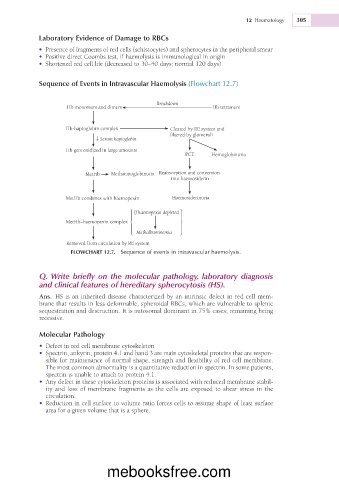
             Sequence of Events in Intravascular Haemolysis (Flowchart 12.7)


                                                 Breakdown
                      Hb monomers and dimers                      Hb tetramers


                     Hb-haptoglobin complex          Cleared by RE system and
                                                     filtered by glomeruli
                              ↓ Serum haptoglobin
                     Hb gets oxidized in large amounts
                                                          PCT     Hemoglobinuria


                           MetHb   Methaemoglobinuria Reabsorption and conversion
                                                      into haemosiderin


                     MetHb combines with haemopexin   Haemosiderinuria
                                          If haemopexin depleted
                     MetHb–haemopexin complex
                                           Methalbuminemia
                     Removed from circulation by RE system
                       FLOWCHART 12.7.  Sequence of events in intravascular haemolysis.


             Q. Write  briefly  on  the  molecular  pathology,  laboratory  diagnosis
             and clinical features of hereditary spherocytosis (HS).
             Ans.  HS is an inherited disease characterized by an intrinsic defect in red cell mem-
             brane that results in less deformable, spheroidal RBCs, which are vulnerable to splenic
             sequestration and destruction. It is autosomal dominant in 75% cases; remaining being
             recessive.


             Molecular Pathology
             •  Defect in red cell membrane cytoskeleton
             •  Spectrin, ankyrin, protein 4.1 and band 3 are main cytoskeletal proteins that are respon-
               sible for maintenance of normal shape, strength and flexibility of red cell membrane.
               The most common abnormality is a quantitative reduction in spectrin. In some patients,
               spectrin is unable to attach to protein 4.1.
             •  Any defect in these cytoskeleton proteins is associated with reduced membrane stabil-
               ity and loss of membrane fragments as the cells are exposed to shear stress in the
               circulation.
             •  Reduction in cell surface to volume ratio forces cells to assume shape of least surface
               area for a given volume that is a sphere.


                                  mebooksfree.com

