


Page 326 - Concise Pathology for Exam Preparation ( PDFDrive )
P. 326
12  Haematology  311

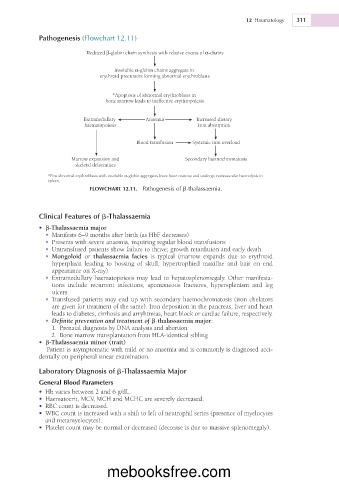
             Pathogenesis (Flowchart 12.11)


                            Reduced β-globin chain synthesis with relative excess of α-chains

                                    Insoluble α-globin chains aggregate in
                                erythroid precursors forming abnormal erythroblasts


                                    *Apoptosis of abnormal erythroblasts in
                                  bone marrow leads to ineffective erythropoiesis

                           Extramedullary     Anaemia        Increased dietary
                           haematopoiesis                     iron absorption

                                           Blood transfusion  Systemic iron overload

                       Marrow expansion and               Secondary haemochromatosis
                        skeletal deformities
                *Few abnormal erythroblasts with insoluble α-globin aggregates leave bone marrow and undergo extravascular haemolysis in
                spleen.

                             FLOWCHART 12.11.  Pathogenesis of b-thalassaemia.


             Clinical Features of b-Thalassaemia
             •  b-Thalassaemia major
               •  Manifests 6–9 months after birth (as HbF decreases)
               •  Presents with severe anaemia, requiring regular blood transfusions
               •  Untransfused patients show failure to thrive; growth retardation and early death
               •  Mongoloid  or  thalassaemia  facies  is  typical  (marrow  expands  due  to  erythroid
                 hyperplasia  leading  to  bossing  of  skull,  hypertrophied  maxillae  and  hair  on  end
                 appearance on X-ray).
               •  Extramedullary haematopoiesis may lead to hepatosplenomegaly. Other manifesta-
                 tions  include  recurrent  infections,  spontaneous  fractures,  hypersplenism  and  leg
                 ulcers.
               •  Transfused patients may end up with secondary haemochromatosis (iron chelators
                 are given for treatment of the same). Iron deposition in the pancreas, liver and heart
                 leads to diabetes, cirrhosis and arryhtmias, heart block or cardiac failure, respectively.
               •  Definite	prevention	and	treatment	of	b-thalassaemia major:
                 1.  Prenatal diagnosis by DNA analysis and abortion
                 2.  Bone marrow transplantation from HLA-identical sibling
             •  b-Thalassaemia minor (trait)
               Patient is asymptomatic with mild or no anaemia and is commonly is diagnosed acci-
             dentally on peripheral smear examination.
             Laboratory Diagnosis of b-Thalassaemia Major

             General Blood Parameters
             •  Hb varies between 2 and 6 g/dL.
             •  Haematocrit, MCV, MCH and MCHC are severely decreased.
             •  RBC count is decreased.
             •  WBC count is increased with a shift to left of neutrophil series (presence of myelocytes
               and metamyelocytes).
             •  Platelet count may be normal or decreased (decrease is due to massive splenomegaly).


                                  mebooksfree.com

