


Page 324 - Concise Pathology for Exam Preparation ( PDFDrive )
P. 324
12  Haematology  309


                      Poikilocyte


                                                                          Target cell
                                                                          Sickle cell


                                                                          Nucleated red
                                                                          cell


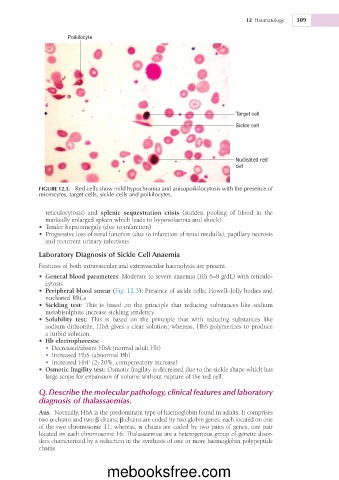
             FIGURE 12.3.  Red cells show mild hypochromia and anisopoikilocytosis with the presence of
             microcytes, target cells, sickle cells and poikilocytes.

               reticulocytosis)  and  splenic  sequestration  crisis  (sudden  pooling  of  blood  in  the
               markedly enlarged spleen which leads to hypovolaemia and shock).
             •  Tender hepatomegaly (due to infarction)
             •  Progressive loss of renal function (due to infarction of renal medulla), papillary necrosis
               and recurrent urinary infections
             Laboratory Diagnosis of Sickle Cell Anaemia
             Features of both intravascular and extravascular haemolysis are present
             •  General blood parameters: Moderate to severe anaemia (Hb 6–8 g/dL) with reticulo-
               cytosis
             •  Peripheral blood smear (Fig. 12.3): Presence of sickle cells; Howell–Jolly bodies and
               nucleated RBCs
             •  Sickling  test:  This  is  based  on  the  principle  that  reducing  substances  like  sodium
               metabisulphite increase sickling tendency.
             •  Solubility  test:  This  is  based  on  the  principle  that  with  reducing  substances  like
               sodium dithionite, HbA gives a clear solution; whereas, HbS polymerizes to produce
               a turbid solution.
             •  Hb electrophoresis:
               •  Decreased/absent HbA (normal adult Hb)
               •  Increased HbS (abnormal Hb)
               •  Increased HbF (2–20%, compensatory increase)
             •  Osmotic fragility test: Osmotic fragility is decreased due to the sickle shape which has
               large scope for expansion of volume without rupture of the red cell.
             Q. Describe the molecular pathology, clinical features and laboratory
             diagnosis of thalassaemias.
             Ans.  Normally, HbA is the predominant type of haemoglobin found in adults. It comprises
             two a chains and two b chains; b chains are coded by two globin genes, each located on one
             of the two chromosome 11; whereas, a chains are coded by two pairs of genes, one pair
             located on each chromosome 16. Thalassaemias are a heterogenous group of genetic disor-
             ders characterized by a reduction in the synthesis of one or more haemoglobin polypeptide
             chains.


                                  mebooksfree.com

