


Page 323 - Concise Pathology for Exam Preparation ( PDFDrive )
P. 323
308    SECTION II  Diseases of Organ Systems

                     Q.  Write  briefly  on  the  pathophysiology,  clinical  features  and
                     laboratory diagnosis of sickle cell disease.
                     Ans.  Sickle  cell  disease  is  a  hereditary  haemoglobinopathy,  which  is  characterized  by
                     point mutation-substitution of glutamic acid (CTG) by valine (CAG) at 6th position in
                     b-globin chain.

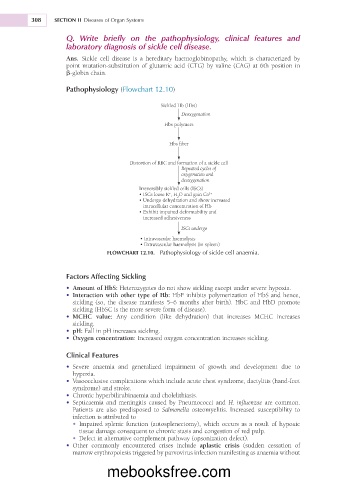
                     Pathophysiology (Flowchart 12.10)


                                                   Sickled Hb (Hbs)
                                                         Deoxygenation
                                                    Hbs polymers


                                                     Hbs fiber


                                         Distortion of RBC and formation of a sickle cell
                                                         Repeated cycles of
                                                         oxygenation and
                                                         deoxygenation
                                            Irreversibly sickled cells (ISCs)
                                            • ISCs loose K , H O and gain Ca 2+
                                                     +
                                                        2
                                            • Undergo dehydration and show increased
                                               intracellular concentration of Hb
                                            • Exhibit impaired deformability and
                                               increased adhesiveness
                                                         ISCs undergo
                                            • Intravascular haemolysis
                                            • Extravascular haemolysis (in spleen)
                                  FLOWCHART 12.10.  Pathophysiology of sickle cell anaemia.


                     Factors Affecting Sickling

                     •  Amount of HbS: Heterozygotes do not show sickling except under severe hypoxia.
                     •  Interaction with other type of Hb: HbF inhibits polymerization of HbS and hence,
                       sickling  (so,  the  disease  manifests  5–6  months  after  birth).  HbC  and  HbD  promote
                       sickling (HbSC is the more severe form of disease).
                     •  MCHC  value:  Any  condition  (like  dehydration)  that  increases  MCHC  increases
                       sickling.
                     •  pH: Fall in pH increases sickling.
                     •  Oxygen concentration: Increased oxygen concentration increases sickling.

                     Clinical Features

                     •  Severe  anaemia  and  generalized  impairment  of  growth  and  development  due  to
                       hypoxia.
                     •  Vasoocclusive complications which include acute chest syndrome, dactylitis (hand-foot
                       syndrome) and stroke.
                     •  Chronic hyperbilirubinaemia and cholelithiasis.
                     •  Septicaemia  and  meningitis  caused  by  Pneumococci  and  H.	 influenzae  are  common.
                       Patients  are  also  predisposed  to  Salmonella  osteomyelitis.	 Increased  susceptibility  to
                       infection is attributed to
                       •  Impaired splenic function (autosplenectomy), which occurs as a result of hypoxic
                         tissue damage consequent to chronic stasis and congestion of red pulp.
                       •  Defect in alternative complement pathway (opsonization defect).
                     •  Other  commonly  encountered  crises  include  aplastic  crisis  (sudden  cessation  of
                       marrow erythropoiesis triggered by parvovirus infection manifesting as anaemia without


                                  mebooksfree.com

