


Page 340 - Concise Pathology for Exam Preparation ( PDFDrive )
P. 340
12  Haematology  325


               •  Periodic acid-Schiff (PAS) shows granular positivity in the erythroblasts of M6 as well
                 as block positivity in blasts of L1 and L2 subtypes of ALL.
               •  Acid phosphatase shows a strong focal positivity in T-cell ALL.
             •  Immunophenotyping in acute leukaemias
               Primary	panel	(to	distinguish	AML	from	ALL	and	classify	B-ALL	and	T-ALL)
               •  Myeloid: CD13, CD33 and CD117
               •  B Lymphoid: CD19, CD79a(cyt), CD22(cyt) and CD10
               •  T Lymphoid: CD3(cyt), CD2 and C7
               •  Nonlineage restricted (primitive stem cell): HLA-R, TDT and CD34
               Secondary	panel	(to	diagnose	AML	of	monocytic,	erythroid,	megakaryocytic	lineage	and
                 further	subtyping	of	B	and	T-cell	ALL)
               •  Myeloid: CD14, CD64, lysozyme, glycophorin A, CD41 and CD61
               •  B Lymphoid: cytIgM, surface Ig (k/l)
               •  T Lymphoid: CD1a, membrane CD3, CD5, CD4 and CD8
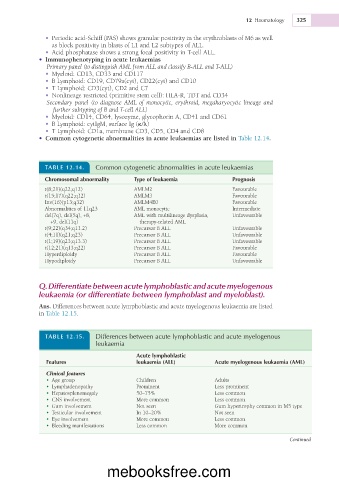
             •  Common cytogenetic abnormalities in acute leukaemias are listed in Table 12.14.


               TABLE 12.14.   Common cytogenetic abnormalities in acute leukaemias
               Chromosomal abnormality    Type of leukaemia              Prognosis
               t(8;21)(q22;q12)           AMLM2                          Favourable
               t(15;17)(q22;q12)          AMLM3                          Favourable
               Inv(16)(p13;q32)           AMLM4E0                        Favourable
               Abnormalities of 11q23     AML monocytic                  Intermediate
               del(7q), del(5q), +8,      AML with multilineage dysplasia,    Unfavourable
                 +9, del(11q)               therapy-related AML
               t(9;22)(q34;q11.2)         Precursor B ALL                Unfavourable
               t(4;11)(q21;q23)           Precursor B ALL                Unfavourable
               t(1;19)(q23;q13.3)         Precursor B ALL                Unfavourable
               t(12;21)(q13;q22)          Precursor B ALL                Favourable
               Hyperdiploidy              Precursor B ALL                Favourable
               Hypodiploidy               Precursor B ALL                Unfavourable


             Q. Differentiate between acute lymphoblastic and acute myelogenous
             leukaemia (or differentiate between lymphoblast and myeloblast).
             Ans. Differences between acute lymphoblastic and acute myelogenous leukaemia are listed
             in Table 12.15.


               TABLE 12.15.   Differences between acute lymphoblastic and acute myelogenous
                              leukaemia

                                           Acute lymphoblastic
               Features                    leukaemia (ALL)         Acute myelogenous leukaemia (AML)
               Clinical features
               •  Age group                Children                Adults
               •  Lymphadenopathy          Prominent               Less prominent
               •  Hepatosplenomegaly       50–75%                  Less common
               •  CNS involvement          More common             Less common
               •  Gum involvement          Not seen                Gum hypertrophy common in M5 type
               •  Testicular involvement   In 10–20%               Not seen
               •  Eye involvement          More common             Less common
               •  Bleeding manifestations   Less common            More common

                                                                                          Continued


                                  mebooksfree.com

