


Page 374 - Concise Pathology for Exam Preparation ( PDFDrive )
P. 374
13  The Lung  359


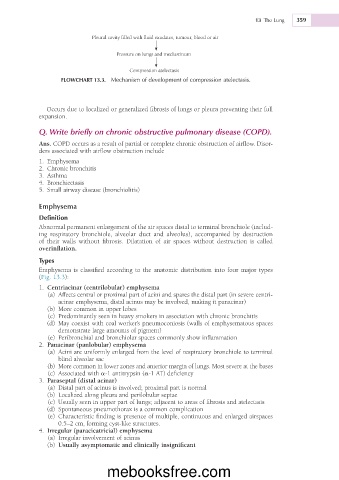
                             Pleural cavity filled with fluid exudates, tumour, blood or air

                                     Pressure on lungs and mediastinum

                                         Compression atelectasis
                    FLOWCHART 13.3.  Mechanism of development of compression atelectasis.


               Occurs due to localized or generalized fibrosis of lungs or pleura preventing their full
             expansion.
             Q. Write briefly on chronic obstructive pulmonary disease (COPD).

             Ans. COPD occurs as a result of partial or complete chronic obstruction of airflow. Disor-
             ders associated with airflow obstruction include
               1.  Emphysema
               2.  Chronic bronchitis
               3.  Asthma
               4.  Bronchiectasis
               5.  Small airway disease (bronchiolitis)

             Emphysema
             Definition
             Abnormal permanent enlargement of the air spaces distal to terminal bronchiole (includ-
             ing  respiratory  bronchiole,  alveolar  duct  and  alveolus),  accompanied  by  destruction
             of  their  walls  without  fibrosis.  Dilatation  of  air  spaces  without  destruction  is  called
             overinflation.
             Types
             Emphysema is classified according to the anatomic distribution into four major types
             (Fig. 13.3):
               1.  Centriacinar (centrilobular) emphysema
                 (a)  Affects central or proximal part of acini and spares the distal part (in severe centri-
                   acinar emphysema, distal acinus may be involved, making it panacinar)
                 (b)  More common in upper lobes
                 (c)  Predominantly seen in heavy smokers in association with chronic bronchitis
                  (d)  May coexist with coal worker’s pneumoconiosis (walls of emphysematous spaces
                   demonstrate large amounts of pigment)
                 (e)  Peribronchial and bronchiolar spaces commonly show inflammation
               2.  Panacinar (panlobular) emphysema
                 (a)  Acini are uniformly enlarged from the level of respiratory bronchiole to terminal
                   blind alveolar sac
                 (b)  More common in lower zones and anterior margin of lungs. Most severe at the bases
                 (c)  Associated with a-1 antitrypsin (a-1 AT) deficiency
               3.  Paraseptal (distal acinar)
                 (a)  Distal part of acinus is involved; proximal part is normal
                 (b)  Localized along pleura and perilobular septae
                 (c)  Usually seen in upper part of lungs; adjacent to areas of fibrosis and atelectasis
                  (d)  Spontaneous pneumothorax is a common complication
                 (e)  Characteristic finding is presence of multiple, continuous and enlarged airspaces
                   0.5–2 cm, forming cyst-like structures.
               4.  Irregular (paracicatricial) emphysema
                 (a)  Irregular involvement of acinus
                 (b)  Usually asymptomatic and clinically insignificant


                                  mebooksfree.com

