


Page 376 - Concise Pathology for Exam Preparation ( PDFDrive )
P. 376
13  The Lung  361


               •  a-1 AT is synthesized in liver and is present in serum, tissue fluid and macro-
                 phages.
               •  Normal a-1 AT phenotype is PiMM.
               •  a-1 AT deficient phenotype is PiZZ.
               •  Eighty percent PiZZ patients end up with emphysema.
               •  Pi null phenotype has no detectable levels of a1 AT.
             •  Role of neutrophils: Neutrophils are a source of:
               •  Elastase activity
               •  Cellular proteases (proteinase 3 and cathepsin)
               •  Matrix metalloproteinases
               •  Oxygen-derived free radicals (inactivate native antiproteases by oxidative injury)
             •  Role of smoking: Smoking enhances elastase activity of macrophages. Macrophage elastase
               is not inhibited by a-1 AT and it can, in fact, digest the latter.

             Clinical Features of Emphysema
             Patients do not become symptomatic until at least one-third of functional parenchyma is
             damaged. Presenting signs and symptoms of emphysema include
             •  Dyspnoea
             •  Cough (late and with scanty sputum)
             •  Severe weight loss
             •  Barrel-shaped chest
             •  Prolonged expiration (key to diagnosis)
             •  Hunched position and breathing through pursed lips
             •  Death may be due to either of the following:
               •  Respiratory acidosis and coma
               •  Right-sided heart failure
               •  Massive collapse of lungs secondary to pneumothorax

             Chronic Bronchitis
             Definition
             Persistent cough with sputum production for at least three months in two consecutive
             years. It is common in habitual smokers and inhabitants of smoke-laden cities and
             may progress to
             •  COPD
             •  Cor pulmonale and heart failure
             •  Atypical metaplasia and dysplasia of respiratory epithelium


             Types
               1.  Simple chronic bronchitis: Productive cough but no physiologic evidence of airflow
                obstruction
               2.  Chronic asthmatic bronchitis: Hyperactive airways with intermittent bronchospasm
                and wheezing
               3.  Obstructive chronic bronchitis: Some patients, eg, heavy smokers, develop chronic
                airflow obstruction usually with associated emphysema

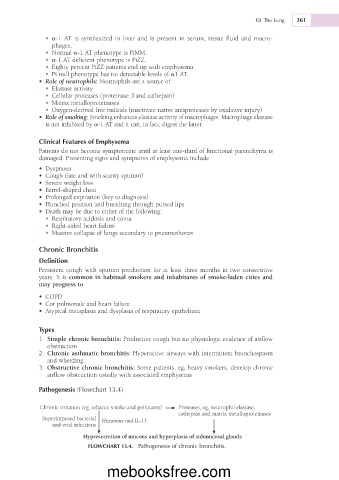
             Pathogenesis (Flowchart 13.4)


             Chronic irritation (eg, tobacco smoke and pollutants)   Proteases, eg, neutrophil elastase,
                                                        cathepsin and matrix metalloproteinases
              Superimposed bacterial  Histamine and IL-13
                 and viral infections
                           Hypersecretion of mucous and hyperplasia of submucosal glands
                            FLOWCHART 13.4.  Pathogenesis of chronic bronchitis.


                                  mebooksfree.com

