


Page 378 - Concise Pathology for Exam Preparation ( PDFDrive )
P. 378
13  The Lung  363


             morning. It is associated with variable degree of bronchoconstriction, inflammation of the
             bronchial walls and increased mucous secretion.
             Pathogenesis
             •  Genetic predisposition to Type I hypersensitivity (atopy) and exposure to certain
               environmental triggers (inhaled allergens like house dust, mites, pets, etc., viruses
               like rhinovirus and respiratory syncytial virus; air pollutants, smoking and drugs like
               beta adrenergic blockers and aspirin) induce bronchial hyper-responsiveness leading to
               acute and chronic airway inflammation.
             •  T H 2  cells  induce  bronchial  inflammation  and  secrete  cytokines  like  interleukin-4
               (which stimulates B cells to produce IgE); interleukin-5 (which activates eosinophils)
               and interleukin-13 (which stimulates mucous secretion from bronchial submucous
               glands)
             •  T H 1 cells normally secrete cytokines that inhibit T H 2 cells and vice versa. Imbal-
               ance in this reciprocal arrangement can lead to the development of asthma. T H 1 cells
               produce g interferon, which suppresses inflammation in airways. A transcription factor,
               called T-bet, required for T H 1 cell differentiation, is found to be absent from lung lym-
               phocytes in asthmatic patients. In the absence of the restraining influence of interferon
               g, T H 2 cells provoke airway inflammation.
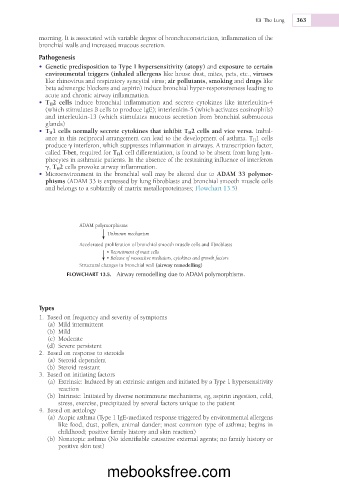
             •  Microenvironment in the bronchial wall may be altered due to ADAM 33 polymor-
               phisms (ADAM 33 is expressed by lung fibroblasts and bronchial smooth muscle cells
               and belongs to a subfamily of matrix metalloproteinases; Flowchart 13.5)


                         ADAM polymorphisms
                                  Unknown mechanism
                         Accelerated proliferation of bronchial smooth muscle cells and fibroblasts
                                  • Recruitment of mast cells
                                  • Release of vasoactive mediators, cytokines and growth factors
                         Structural changes in bronchial wall (airway remodelling)
                      FLOWCHART 13.5.  Airway remodelling due to ADAM polymorphisms.


             Types
               1.  Based on frequency and severity of symptoms
                 (a)  Mild intermittent
                 (b)  Mild
                 (c)  Moderate
                  (d)  Severe persistent
               2.  Based on response to steroids
                 (a)  Steroid dependent
                 (b)  Steroid resistant
               3.  Based on initiating factors
                 (a)  Extrinsic: Induced by an extrinsic antigen and initiated by a Type 1 hypersensitivity
                   reaction
                 (b)  Intrinsic: Initiated by diverse nonimmune mechanisms, eg, aspirin ingestion, cold,
                   stress, exercise, precipitated by several factors unique to the patient
               4.  Based on aetiology
                 (a)  Atopic asthma (Type 1 IgE-mediated response triggered by environmental allergens
                   like food, dust, pollen, animal dander; most common type of asthma; begins in
                   childhood; positive family history and skin reaction)
                 (b)  Nonatopic asthma (No identifiable causative external agents; no family history or
                   positive skin test)


                                  mebooksfree.com

