


Page 409 - Concise Pathology for Exam Preparation ( PDFDrive )
P. 409
394
           394    SECTION II  Diseases of Organ Systems
                     Pathogenesis (Flowchart 14.1)


                                               Prolonged recurrent GE reflux

                                     Inflammation and ulceration of squamous epithelial lining of
                                              the lower segment of oesophagus

                                      Re-epithelialization and in growth of pluripotent stem cells
                                                              Squamous epithelium replaced by
                                                              metaplastic columnar epithelium of the
                                                              intestinal type (columnar epithelium shows
                                                              a greater resistance to acid injury than
                                                              squamous epithelium)
                           In an environment of sustained low pH, these cells may become dysplastic (0.2–2% patients)
                                                      Dysplasia


                                                 Low grade  High grade
                                                   Adenocarcinoma
                                          (may involve, adjacent cardiac end of stomach)
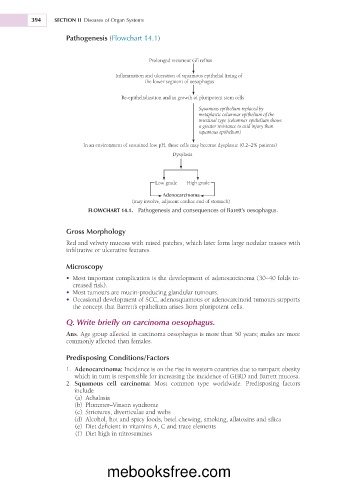
                            FLOWCHART 14.1.  Pathogenesis and consequences of Barett’s oesophagus.


                     Gross Morphology
                     Red and velvety mucosa with raised patches, which later form large nodular masses with
                     infiltrative or ulcerative features.

                     Microscopy

                     •	 Most important complication is the development of adenocarcinoma (30–40 folds in-
                       creased risk).
                     •	 Most tumours are mucin-producing glandular tumours.
                     •	 Occasional development of SCC, adenosquamous or adenocarcinoid tumours supports
                       the concept that Barrett’s epithelium arises from pluripotent cells.

                     Q. Write briefly on carcinoma oesophagus.

                     Ans. Age group affected in carcinoma oesophagus is more than 50 years; males are more
                     commonly affected than females.

                     Predisposing Conditions/Factors
                       1.  Adenocarcinoma:	Incidence is on the rise in western countries due to rampant obesity
                        which in turn is responsible for increasing the incidence of GERD and Barrett mucosa.
                       2.  Squamous	 cell	 carcinoma:	 Most  common  type  worldwide.  Predisposing  factors
                        include
                         (a)  Achalasia
                         (b)  Plummer–Vinson syndrome
                         (c)  Strictures, diverticulae and webs
                          (d)  Alcohol, hot and spicy foods, betel chewing, smoking, aflatoxins and silica
                         (e)  Diet deficient in vitamins A, C and trace elements
                         (f   )  Diet high in nitrosamines


                                  mebooksfree.com

