


Page 410 - Concise Pathology for Exam Preparation ( PDFDrive )
P. 410
14  The Oral Cavity and Gastrointestinal Tract  395


             Clinical Features
             Dysphagia/odynophagia, weight loss, iron deficiency, haemorrhage and sepsis from the
             tumour, chest pain and vomiting.

             Gross Morphology

             60% polypoidal (fungating) lesions, 25% ulcerative and 15% diffuse infiltrating lesions.

             Microscopy
             •	 Majority are SCCs which involve the upper thoracic segment (half occurring in middle
               third of oesophagus).
             •	 May be superficial (carcinoma limited to mucosa and submucosa) or advanced (infiltrat-
               ing into muscularis propria). Superficial lesions have a much better prognosis.
             •	 Adenocarcinomas and undifferentiated carcinomas are less common.
             •	 Adenocarcinomas usually arise in oesophageal mucous glands or Barrett’s oesophagus.
             •	 Visceral metastasis to liver, lung and kidney is early and frequent.
             •	 Overall prognosis is very poor.

             STOMACH
             Stomach is a saccular organ with a volume of about 1.5 L. It is divided into five anatomic
             regions, each of which has different histology and functions. These are
                1. Cardia: Where the contents of the oesophagus empty into the stomach
                2. Fundus: Formed by the upper curvature of the organ
                3. Body: Main central dome-shaped part
                4. Pylorus: Lower part, which empties the contents of stomach into the small intestine
                5. Pyloric sphincter: Stomach demarcated from the duodenum by this muscular sphincter

             Layers of Stomach
             •	 Mucosa:  Consists  of  epithelium,  lamina  propria  and  a  thin  layer  of  smooth  muscle
               labelled muscularis mucosae
             •	 Submucosa: Consists of fibrous connective tissue with the Meissner’s plexus
             •	 Muscularis externa: Three layers of smooth muscle, namely:
               •	 Inner oblique layer
               •	 Middle circular layer
               •	 Outer longitudinal layer
                Auerbach’s plexus is found between the outer longitudinal layer and middle circular layer.
             Normal	gastric	mucosa	has	two	compartments:
               1.  Superficial foveolar, which is uniform throughout the stomach.
               2.  Deeper glandular compartment which has different types of cells found in the different
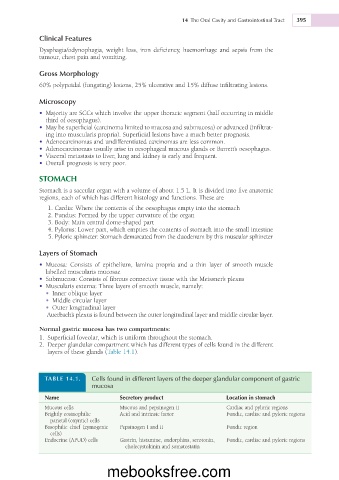
                layers of these glands (Table 14.1).


               TABLE 14.1.   Cells found in different layers of the deeper glandular component of gastric
                             mucosa

               Name                   Secretory product                Location in stomach
               Mucous cells           Mucous and pepsinogen II         Cardiac and pyloric regions
               Brightly eosinophilic    Acid and intrinsic factor      Fundic, cardiac and pyloric regions
                 parietal (oxyntic) cells
               Basophilic  chief (zymogenic   Pepsinogen I and II      Fundic region
                 cells)
               Endocrine (APUD) cells  Gastrin, histamine, endorphins, serotonin,   Fundic, cardiac and pyloric regions
                                        cholecystokinin and somatostatin


                                  mebooksfree.com

