


Page 422 - Concise Pathology for Exam Preparation ( PDFDrive )
P. 422
14  The Oral Cavity and Gastrointestinal Tract  407


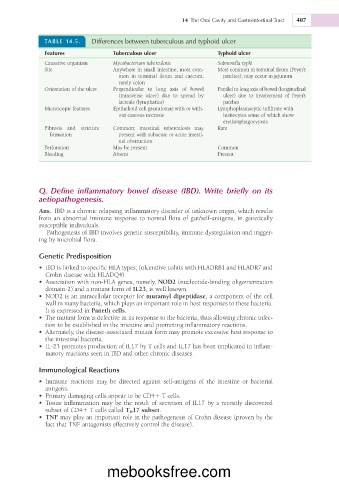
               TABLE 14.5.   Differences between tuberculous and typhoid ulcer

               Features             Tuberculous ulcer               Typhoid ulcer
               Causative organism   Mycobacterium tuberculosis      Salmonella typhi
               Site                 Anywhere in small intestine; most com-  Most common in terminal ileum (Peyer’s
                                      mon  in  terminal  ileum  and  caecum,   patches); may occur in jejunum
                                      rarely colon
               Orientation of the ulcer   Perpendicular  to  long  axis  of  bowel   Parallel to long axis of bowel (longitudinal
                                      (transverse  ulcer)  due  to  spread  by   ulcer)  due  to  involvement  of  Peyer’s
                                      lacteals (lymphatics)           patches
               Microscopic features  Epithelioid cell granulomas with or with-  Lymphoplasmacytic infiltrate with
                                      out caseous necrosis            histiocytes some of which show
                                                                      erythrophagocytosis
               Fibrosis  and  stricture   Common;  intestinal  tuberculosis  may   Rare
                formation             present with subacute or acute intesti-
                                      nal obstruction
               Perforation          May be present                  Common
               Bleeding             Absent                          Present


             Q.  Define  inflammatory  bowel  disease  (IBD).  Write  briefly  on  its
             aetiopathogenesis.

             Ans.  IBD is a chronic relapsing inflammatory disorder of unknown origin, which results
             from an abnormal immune response to normal flora of gut/self-antigens, in genetically
             susceptible individuals.
               Pathogenesis of IBD involves genetic susceptibility, immune dysregulation and trigger-
             ing by microbial flora.

             Genetic Predisposition

             •	 IBD is linked to specific HLA types; (ulcerative colitis with HLADRB1 and HLADR7 and
               Crohn disease with HLADQ4).
             •	 Association with non-HLA genes, namely, NOD2 (nucleotide-binding oligomerization
               domain-2) and a mutant form of IL23, is well known.
             •	 NOD2 is an intracellular receptor for muramyl	dipeptidase, a component of the cell
               wall in many bacteria, which plays an important role in host responses to these bacteria.
               It is expressed in Paneth	cells.
             •	 The mutant form is defective in its response to the bacteria, thus allowing chronic infec-
               tion to be established in the intestine and promoting inflammatory reactions.
             •	 Alternately, the disease-associated mutant form may promote excessive host response to
               the intestinal bacteria.
             •	 IL-23 promotes production of IL17 by T cells and IL17 has been implicated in inflam-
               matory reactions seen in IBD and other chronic diseases.

             Immunological Reactions

             •	 Immune  reactions  may  be  directed  against  self-antigens  of  the  intestine  or  bacterial
               antigens.
             •	 Primary damaging cells appear to be CD41 T cells.
             •	 Tissue inflammation may be the result of secretion of IL17 by a recently discovered
               subset of CD41 T cells called T H 17	subset.
             •	 TNF	may play an important role in the pathogenesis of Crohn disease (proven by the
               fact that TNF antagonists effectively control the disease).


                                  mebooksfree.com

