


Page 420 - Concise Pathology for Exam Preparation ( PDFDrive )
P. 420
14  The Oral Cavity and Gastrointestinal Tract  405


             •	 Oedema due to protein deficiency
             •	 Dermatitis, mucositis and hyperkeratosis due to vitamin A, zinc, essential fatty acids and
               niacin deficiency
             •	 Osteopenia and tetany due to defective calcium absorption
             •	 Amenorrhea, impotence and infertility from generalized malnutrition
             •	 Hyperparathyroidism due to protracted calcium and vitamin deficiency

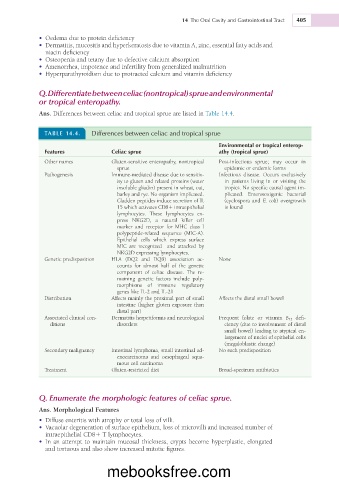
             Q. Differentiate between celiac (nontropical) sprue and environmental
             or tropical enteropathy.
             Ans. Differences between celiac and tropical sprue are listed in Table 14.4.


               TABLE 14.4.   Differences between celiac and tropical sprue
                                                                    Environmental or tropical enterop-
               Features            Celiac sprue                     athy (tropical sprue)
               Other names         Gluten-sensitive enteropathy, nontropical   Post-infectious  sprue;  may  occur  in
                                     sprue                            epidemic or endemic forms
               Pathogenesis        Immune-mediated disease due to sensitiv-  Infectious  disease.  Occurs  exclusively
                                     ity to gluten and related proteins (water   in  patients  living  in  or  visiting  the
                                     insoluble gliadin) present in wheat, oat,   tropics. No specific causal agent im-
                                     barley and rye. No organism implicated.   plicated.  Enterotoxigenic  bacterial
                                     Gladden peptides induce secretion of IL   (cyclospora  and  E.  coli)  overgrowth
                                     15 which activates CD81 intraepithelial   is found
                                     lymphocytes.  These  lymphocytes  ex-
                                     press  NKG2D,  a  natural  killer  cell
                                     marker  and  receptor  for  MHC  class  I
                                     polypeptide-related  sequence  (MIC-A).
                                     Epithelial  cells  which  express  surface
                                     MIC  are  recognized    and  attacked  by
                                     NKG2D expressing lymphocytes.
               Genetic predisposition  HLA  (DQ2  and  DQ8)  association  ac-  None
                                     counts  for  almost  half  of  the  genetic
                                     component  of  celiac  disease.  The  re-
                                     maining  genetic  factors  include  poly-
                                     morphisms  of  immune  regulatory
                                     genes like IL-2 and IL-21
               Distribution        Affects mainly the proximal part of small   Affects the distal small bowel
                                     intestine (higher gluten exposure than
                                     distal part)
               Associated clinical con-  Dermatitis herpetiformis and neurological   Frequent  folate  or  vitamin  B 12   defi-
                ditions              disorders                        ciency (due to involvement of distal
                                                                      small bowel) leading to atypical en-
                                                                      largement of nuclei of epithelial cells
                                                                      (megaloblastic change)
               Secondary malignancy  Intestinal lymphoma, small intestinal ad-  No such predisposition
                                     enocarcinoma  and  oesophageal  squa-
                                     mous cell carcinoma
               Treatment           Gluten-restricted diet           Broad-spectrum antibiotics


             Q. Enumerate the morphologic features of celiac sprue.
             Ans.	Morphological	Features
             •	 Diffuse enteritis with atrophy or total loss of villi.
             •	 Vacuolar degeneration of surface epithelium, loss of microvilli and increased number of
               intraepithelial CD81 T lymphocytes.
             •	 In an attempt to maintain mucosal thickness, crypts become hyperplastic, elongated
               and tortuous and also show increased mitotic figures.


                                  mebooksfree.com

