


Page 417 - Concise Pathology for Exam Preparation ( PDFDrive )
P. 417
402
           402    SECTION II  Diseases of Organ Systems

                     •	 Racial factors
                        More common in Blacks, Americans and Indians
                     •	 Geographical influence
                        More prevalent in Japan, Finland and Iceland
                     Location

                     •	 Pylorus and antrum (50–60%)
                     •	 Cardia (25%)
                     •	 Body and fundus (15–25%)
                        Less curvature is involved more often as compared to greater curvature and most com-
                     mon location is lesser curvature of antropyloric region.
                     Classification
                       1.  Microscopic	or	histological	(Lauren)	classification
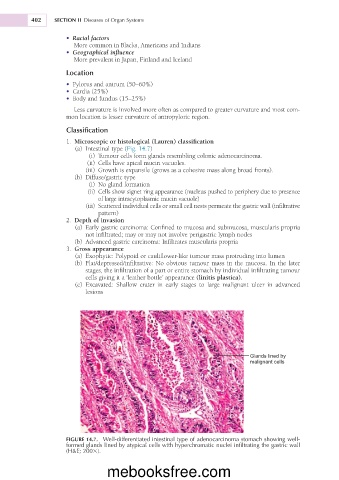
                         (a)  Intestinal type (Fig. 14.7)
                             (i)  Tumour cells form glands resembling colonic adenocarcinoma.
                            (ii)  Cells have apical mucin vacuoles.
                             (iii)  Growth is expansile (grows as a cohesive mass along broad fronts).
                         (b)  Diffuse/gastric type
                             (i)  No gland formation
                            (ii)  Cells show signet ring appearance (nucleus pushed to periphery due to presence
                               of large intracytoplasmic mucin vacuole)
                            (iii)  Scattered individual cells or small cell nests permeate the gastric wall (infiltrative
                               pattern)
                       2.  Depth	of	invasion
                         (a)  Early gastric carcinoma: Confined to mucosa and submucosa, muscularis propria
                           not infiltrated; may or may not involve perigastric lymph nodes
                         (b)  Advanced gastric carcinoma: Infiltrates muscularis propria
                       3.  Gross	appearance
                         (a)  Exophytic: Polypoid or cauliflower-like tumour mass protruding into lumen
                         (b)  Flat/depressed/infiltrative: No obvious tumour mass in the mucosa. In the later
                           stages, the infiltration of a part or entire stomach by individual infiltrating tumour
                           cells giving it a ‘leather bottle’ appearance (linitis	plastica).
                         (c)  Excavated:  Shallow  crater  in  early  stages  to  large  malignant  ulcer  in  advanced
                           lesions


                                                                              Glands lined by
                                                                              malignant cells


                     FIGURE 14.7.  Well-differentiated intestinal type of adenocarcinoma stomach showing well-
                     formed glands lined by atypical cells with hyperchromatic nuclei infiltrating the gastric wall
                     (H&E; 2003).


                                  mebooksfree.com

