


Page 434 - Concise Pathology for Exam Preparation ( PDFDrive )
P. 434
14  The Oral Cavity and Gastrointestinal Tract  419


             •	 Cough, dyspnoea and wheezing (asthmatic bronchoconstrictive attack due to released mediators)
             •	 Hepatic metastasis causing nodular liver (hepatomegaly) in some patients
             •	 Systemic fibrosis involving heart (right-sided valvular stenosis and endocardial fibrosis),
               retroperitoneal and pelvic fibrosis in other patients

             Q. Describe the clinicopathological features of acute appendicitis.

             Ans. Acute appendicitis is defined as acute inflammation of appendix. It is generally seen
             in children and young adult and results from obstruction,	which may be due to:
             •	 Fecolith
             •	 Tumour
             •	 Foreign body
             •	 Oxyuris vermicularis
             •	 Diffuse lymphoid hyperplasia

             Other Causes
             •	 Inappropriate intake of roughage
             •	 Haematogenous spread of infection to appendix
             •	 Vascular occlusion
             •	 Idiopathic


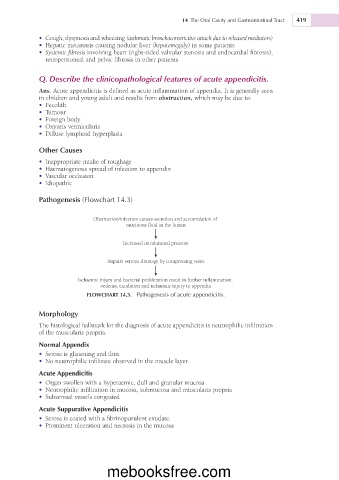
             Pathogenesis (Flowchart 14.3)


                              Obstruction/infection causes secretion and accumulation of
                                        mucinous fluid in the lumen

                                       Increased intraluminal pressure


                                  Impairs venous drainage by compressing veins

                         Ischaemic injury and bacterial proliferation result in further inflammation,
                                oedema, exudation and ischaemic injury to appendix
                            FLOWCHART 14.3.  Pathogenesis of acute appendicitis.


             Morphology
             The histological hallmark for the diagnosis of acute appendicitis is neutrophilic infiltration
             of the muscularis propria.

             Normal Appendix
             •	 Serosa is glistening and thin.
             •	 No neutrophilic infiltrate observed in the muscle layer.
             Acute Appendicitis
             •	 Organ swollen with a hyperaemic, dull and granular mucosa
             •	 Neutrophilic infiltration in mucosa, submucosa and muscularis propria
             •	 Subserosal vessels congested
             Acute Suppurative Appendicitis
             •	 Serosa is coated with a fibrinopurulent exudate.
             •	 Prominent ulceration and necrosis in the mucosa


                                  mebooksfree.com

