


Page 435 - Concise Pathology for Exam Preparation ( PDFDrive )
P. 435
15


                     Diseases of the Hepatobiliary


                     System and Pancreas


                     LIVER
                     •	 Largest solid organ in the body (1200–1500 g)
                     •	 Divided into right and left lobes by the falciform ligament, the fissure of ligamentum
                       teres and the fissure of ligamentum venosum
                     •	 Surgical division into right	and	left	hemilivers by the middle hepatic vein, which
                       lies between the inferior vena cava and the gallbladder, and passes through the porta
                       hepatis
                     •	 The right and left hemilivers are further subdivided into a total of 8 segments in accor-
                       dance with subdivisions of hepatic vasculature.
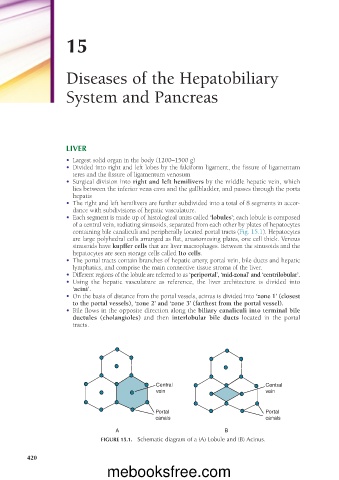
                     •	 Each segment is made up of histological units called ‘lobules’; each lobule is composed
                       of a central vein, radiating sinusoids, separated from each other by plates of hepatocytes
                       containing bile canaliculi and peripherally located portal tracts (Fig. 15.1). Hepatocytes
                       are large polyhedral cells arranged as flat, anastomosing plates, one cell thick. Venous
                       sinusoids have kupffer	cells	that are liver macrophages. Between the sinusoids and the
                       hepatocytes are seen storage cells called Ito	cells.
                     •	 The portal tracts contain branches of hepatic artery, portal vein, bile ducts and hepatic
                       lymphatics, and comprise the main connective tissue stroma of the liver.
                     •	 Different regions of the lobule are referred to as ‘periportal’,	‘mid-zonal’	and	‘centrilobular’.
                     •	 Using  the  hepatic  vasculature  as  reference,  the  liver  architecture  is  divided  into
                       ‘acini’.
                     •	 On the basis of distance from the portal vessels, acinus is divided into ‘zone	1’	(closest
                       to	the	portal	vessels),	‘zone	2’	and	‘zone	3’	(farthest	from	the	portal	vessel).
                     •	 Bile flows in the opposite direction along the biliary	canaliculi	into	terminal	bile
                       ductules	 (cholangioles)  and  then  interlobular	 bile	 ducts	 located  in  the  portal
                       tracts.


                                                 Central                           Central
                                                 vein                              vein


                                                 Portal                            Portal
                                                 canals                            canals
                                     A                                B
                                FIGURE 15.1.  Schematic diagram of a (A) Lobule and (B) Acinus.

         420
         420
                                  mebooksfree.com

