


Page 438 - Concise Pathology for Exam Preparation ( PDFDrive )
P. 438
15  Diseases of the Hepatobiliary System and Pancreas  423

             Q. Write briefly on bilirubin metabolism.

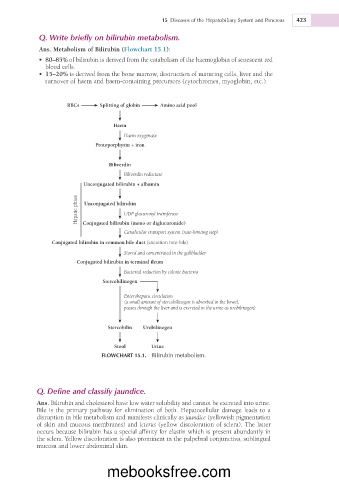
             Ans.	Metabolism	of	Bilirubin	(Flowchart	15.1):
             •	 80–85% of bilirubin is derived from the catabolism of the haemoglobin of senescent red
               blood cells.
             •	 15–20% is derived from the bone marrow, destruction of maturing cells, liver and the
               turnover of haem and haem-containing precursors (cytochromes, myoglobin, etc.).


                      RBCs      Splitting of globin  Amino acid pool


                                    Haem
                                       Haem oxygenase
                              Protoporphyrin + iron


                                   Biliverdin
                                       Biliverdin reductase
                           Unconjugated bilirubin + albumin

                         Hepatic phase  Unconjugated bilirubin
                                       UDP glucuronyl transferase
                           Conjugated bilirubin (mono or diglucuronide)
                                       Canalicular transport system (rate-limiting step)
                 Conjugated bilirubin in common bile duct (excretion into bile)
                                       Stored and concentrated in the gallbladder
                         Conjugated bilirubin in terminal ileum
                                       Bacterial reduction by colonic bacteria
                                 Stercobilinogen
                                       Enterohepatic circulation
                                       (a small amount of stercobilinogen is absorbed in the bowel;
                                       passes through the liver and is excreted in the urine as urobilinogen)

                                  Stercobilin  Urobilinogen


                                    Stool       Urine
                                FLOWCHART 15.1.  Bilirubin metabolism.


            Q. Define and classify jaundice.

            Ans. Bilirubin and cholesterol have low water solubility and cannot be excreted into urine.
            Bile is the primary pathway for elimination of both. Hepatocellular damage leads to a
            disruption in bile metabolism and manifests clinically as jaundice (yellowish pigmentation
            of skin and mucous membranes) and icterus (yellow discoloration of sclera). The latter
            occurs because bilirubin has a special affinity for elastin which is present abundantly in
            the sclera. Yellow discoloration is also prominent in the palpebral conjunctiva, sublingual
            mucosa and lower abdominal skin.


                                  mebooksfree.com

