


Page 439 - Concise Pathology for Exam Preparation ( PDFDrive )
P. 439
424    SECTION II  Diseases of Organ Systems

                     Clinical Features of Jaundice

                     •	 Jaundice (excess bilirubin deposited in the skin and mucosae)
                     •	 Dark urine (results from excess bilirubin excreted by the kidneys)
                     •	 Light-coloured stools (passage of bilirubin into the intestine is blocked)
                     •	 Generalized itchiness (retention of bile products in the skin may cause itching, with
                       subsequent scratching and skin damage)
                     •	 Stools may contain too much fat (a condition called steatorrhoea) because bile cannot
                       enter the intestine to help digest fat in foods
                     •	 There is impaired absorption of calcium, vitamin D and K due to decreased entry of bile
                       in the intestine. The patient has a tendency to bleed due to deficiency of vitamin K.


                     Classification of Jaundice
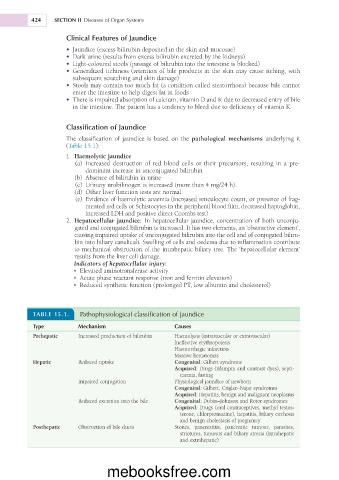
                     The  classification  of  jaundice  is  based  on  the  pathological	 mechanisms  underlying  it
                     (Table 15.1):
                       1.  Haemolytic	jaundice
                         (a)  Increased  destruction  of  red  blood  cells  or  their  precursors,  resulting  in  a  pre-
                           dominant increase in unconjugated bilirubin
                         (b)  Absence of bilirubin in urine
                         (c)  Urinary urobilinogen is increased (more than 4 mg/24 h).
                          (d)  Other liver function tests are normal.
                         (e)  Evidence of haemolytic anaemia (increased reticulocyte count, or presence of frag-
                           mented red cells or Schistocytes in the peripheral blood film, decreased haptoglobin,
                           increased LDH and positive direct Coombs test)
                      2.  Hepatocellular	 jaundice:	 In  hepatocellular  jaundice,  concentration  of  both  unconju-
                        gated and conjugated bilirubin is increased. It has two elements, an ‘obstructive element’,
                        causing impaired uptake of unconjugated bilirubin into the cell and of conjugated biliru-
                        bin into biliary canaliculi. Swelling of cells and oedema due to inflammation contribute
                        to mechanical obstruction of the intrahepatic biliary tree. The ‘hepatocellular element’
                        results from the liver cell damage.
                        Indicators of hepatocellular injury:
                        •	 Elevated aminotransferase activity
                        •	 Acute phase reactant response (iron and ferritin elevation)
                        •	 Reduced synthetic function (prolonged PT, low albumin and cholesterol)


           TABLE 15.1.    Pathophysiological classification of jaundice
           Type          Mechanism                     Causes
           Prehepatic    Increased production of bilirubin  Haemolysis (intravascular or extravascular)
                                                       Ineffective erythropoiesis
                                                       Haemorrhagic infarction
                                                       Massive hematomas
           Hepatic       Reduced uptake                Congenital: Gilbert syndrome
                                                       Acquired: Drugs (rifampin and contrast dyes), septi-
                                                        caemia, fasting
                         Impaired conjugation          Physiological jaundice of newborn
                                                       Congenital: Gilbert, Crigler–Najar syndromes
                                                       Acquired: Hepatitis, benign and malignant neoplasms
                         Reduced excretion into the bile  Congenital: Dubin–Johnson and Rotor syndromes
                                                       Acquired: Drugs (oral contraceptives, methyl testos-
                                                        terone, chlorpromazine), hepatitis, biliary cirrhosis
                                                        and benign cholestasis of pregnancy
           Posthepatic   Obstruction of bile ducts     Stones,  pancreatitis,  pancreatic  tumour,  parasites,
                                                        strictures, tumours and biliary atresia (intrahepatic
                                                        and extrahepatic)


                                  mebooksfree.com

