


Page 442 - Concise Pathology for Exam Preparation ( PDFDrive )
P. 442
15  Diseases of the Hepatobiliary System and Pancreas  427


                 •	 Another  soluble  antigen  in  the  nucleocapsid  is  called  hepatitis  B  e-antigen  or
                   HBeAg)
                 •	 A DNA	polymerase	enzyme	(pol)	that exhibits reverse transcriptase activity
                 •	 A protein from the X region, HBX necessary for viral replication; HBX controls
                   gene transcription and thus acts as a gatekeeper for hepatocyte check points in cell
                   cycle.
               •	 The	corresponding	antibodies	are
                 •	 Anti-HBs
                 •	 Anti-HBc
                 •	 Anti-HBe
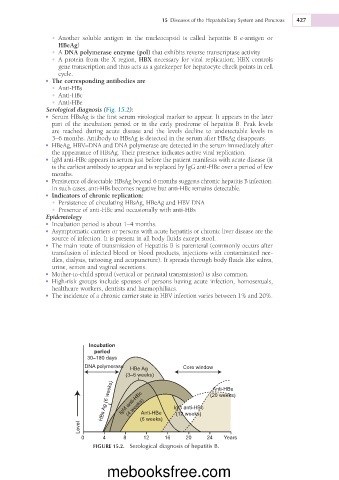
               Serological diagnosis (Fig. 15.2):
               •	 Serum HBsAg is the first serum virological marker to appear. It appears in the later
                 part of the incubation period or in the early prodrome of hepatitis B. Peak levels
                 are  reached  during  acute  disease  and  the  levels  decline  to  undetectable  levels  in
                 3–6 months. Antibody to HBsAg is detected in the serum after HBsAg disappears.
               •	 HBeAg, HBV–DNA and DNA polymerase are detected in the serum immediately after
                 the appearance of HBsAg. Their presence indicates active viral replication.
               •	 IgM anti-HBc appears in serum just before the patient manifests with acute disease (it
                 is the earliest antibody to appear and is replaced by IgG anti-HBc over a period of few
                 months.
               •	 Persistence of detectable HBsAg beyond 6 months suggests chronic hepatitis B infection.
                 In such cases, anti-HBs becomes negative but anti-HBc remains detectable.
               •	 Indicators	of	chronic	replication:
                 •	 Persistence of circulating HBsAg, HBeAg and HBV DNA
                 •	 Presence of anti-HBc and occasionally with anti-HBs
               Epidemiology
               •	 Incubation period is about 1–4 months.
               •	 Asymptomatic carriers or persons with acute hepatitis or chronic liver disease are the
                 source of infection. It is present in all body fluids except stool.
               •	 The main route of transmission of Hepatitis B is parenteral (commonly occurs after
                 transfusion of infected blood or blood products, injections with contaminated nee-
                 dles, dialysis, tattooing and acupuncture). It spreads through body fluids like saliva,
                 urine, semen and vaginal secretions.
               •	 Mother-to-child spread (vertical or perinatal transmission) is also common.
               •	 High-risk groups include spouses of persons having acute infection, homosexuals,
                 healthcare workers, dentists and haemophiliacs.
               •	 The incidence of a chronic carrier state in HBV infection varies between 1% and 20%.


                            Incubation
                              period
                            30–180 days
                           DNA polymerase  HBe Ag        Core window
                                        (3–6 weeks)
                                HBs Ag (6 weeks)  IgM anti-HBc  Anti-HBe  IgG anti-HBc  (20 weeks)
                                                                  Anti-HBs
                                        (4 weeks)

                                                       (12 weeks)
                         Level              (6 weeks)
                          0      4     8     12     16    20     24   Years
                              FIGURE 15.2.  Serological diagnosis of hepatitis B.


                                  mebooksfree.com

