


Page 448 - Concise Pathology for Exam Preparation ( PDFDrive )
P. 448
15  Diseases of the Hepatobiliary System and Pancreas  433

             Q. Write briefly on Reye syndrome.

             Ans. Reye syndrome is mainly seen in children and adolescents, and is rare in adults.
             •	 It is characterized by severe fatty degeneration of the liver and usually follows a viral illness.
             •	 History of aspirin intake may be elicited.
             •	 It manifests with acute encephalopathy with cerebral oedema and is a prototype of con-
               ditions called ‘mitochondrial	hepatopathies’	(causes generalized loss of mitochondrial
               function).

             Q. Write briefly on autoimmune (lupoid) hepatitis.

             Ans. It is a chronic hepatitis with multiple immunologic abnormalities. The following are
             the salient features of autoimmune hepatitis:
             •	 Female preponderance; HLA association (association with HLADRB1 allelles in Caucasians)
             •	 Insidious onset with fatigue, anorexia and jaundice
             •	 Signs of chronic liver disease (spider telangiectasia and hepatosplenomegaly)
             •	 Coexistence of other autoimmune diseases (rheumatoid arthritis, thyrotoxicosis, Hashi-
               moto thyroiditis, myxoedema, Coombs positive haemolytic anaemia)
             •	 Absence of serologic markers of viral infections
             •	 Elevation of serum IgG (.2.5 g/dL) and high titres of autoantibodies eg, antinuclear an-
               tibodies (ANAs), antismooth muscle antibodies (SMAs) like antibodies to actin, troponin
               and  tropomyosin,  antisoluble  liver  antigen/liver  pancreas  antigen  (SLA/LP)  antibodies,
               antiliver cytosol 1 (ACL-1) antibodies. liver–kidney microsomal antibody directed against
               cytochrome P450 and antisoluble liver/kidney microsomes (anti-LKM1 antibody).
             •	 Two types of autoimmune hepatitis are identified – Type 1 is more common in older
               individuals  and  shows  positivity  for  ANA,  SMA,  anti-SLA/LP  and  AMA  and  Type  2
               which affects children and young adults and shows positivity for anti-LKM-1 antibodies
               and ACL-1 antibodies.
             •	 Confluent necrosis, severe interface hepatitis, predominance of plasma cells and roset-
               ting of hepatocytes are diagnostic histopathological features.

             Q. Define cirrhosis. Enumerate its causes and consequences.
             Ans.	 Cirrhosis	is	a	diffuse	liver	disease	characterized	by:
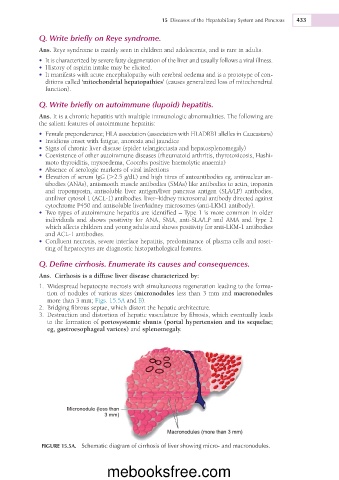
               1.  Widespread hepatocyte necrosis with simultaneous regeneration leading to the forma-
                tion of nodules of various sizes (micronodules less than 3 mm and macronodules
                more than 3 mm; Figs. 15.5A and B).
               2.  Bridging fibrous septae, which distort the hepatic architecture.
               3.  Destruction and distortion of hepatic vasculature by fibrosis, which eventually leads
                to the formation of portosystemic	shunts	(portal	hypertension	and	its	sequelae;
                eg,	gastroesophageal	varices) and splenomegaly.


              FIGURE 15.5A.  Schematic diagram of cirrhosis of liver showing micro- and macronodules.


                                  mebooksfree.com

