


Page 446 - Concise Pathology for Exam Preparation ( PDFDrive )
P. 446
15  Diseases of the Hepatobiliary System and Pancreas  431


               2.  Chronic	lobular	hepatitis	(CLH)
                 (a)  Uncommon disease with evidence of hepatitis B or hepatitis C virus infection.
                 (b)  Antinuclear antibodies, antismooth muscle antibodies and antimitochondrial anti-
                   bodies in some patients.
                 (c)  Live biopsy shows features similar to acute viral hepatitis.
               3.  Chronic	active	hepatitis	(CAH)
                 (a)  Both portal tracts and parenchyma are involved.
                 (b)  Lobular architecture is distorted.
                 (c)  Portal tract inflammation spills over into surrounding parenchyma.
                  (d)  ‘Piecemeal	necrosis’ and ‘bridging	hepatic	necrosis’	seen.
                 (e)  Regenerative nodules develop and later progress to cirrhosis.
             New classification of chronic hepatitis is based on:
               1.  Cause of hepatitis
               2.  Histological activity or grade
               3.  Degree of progression or stage
               Grading of chronic hepatitis is based on the histopathological evidence of inflamma-
             tion and necrosis. Proportionate to the severity of following factors, a severity score (mild,
             moderate or severe) is as signed.
               1.  Periportal necrosis including piecemeal necrosis and/or bridging necrosis
               2.  Intralobular necrosis
               3.  Portal inflammation
               4.  Fibrosis
               Staging of chronic hepatitis is based on the degree of fibrosis (stage 0 with no fibrosis
             to stage 4 with cirrhosis).
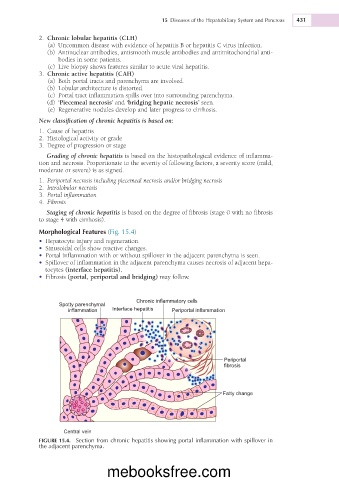
             Morphological Features (Fig. 15.4)
             •	 Hepatocyte injury and regeneration.
             •	 Sinusoidal cells show reactive changes.
             •	 Portal inflammation with or without spillover in the adjacent parenchyma is seen.
             •	 Spillover of inflammation in the adjacent parenchyma causes necrosis of adjacent hepa-
               tocytes (interface	hepatitis).
             •	 Fibrosis (portal,	periportal	and	bridging) may follow.


                                           Chronic inflammatory cells
                   Spotty parenchymal
                      inflammation  Interface hepatitis  Periportal inflammation


                                                                      Periportal
                                                                      fibrosis


                                                                      Fatty change


                     Central vein
             FIGURE 15.4.  Section from chronic hepatitis showing portal inflammation with spillover in
             the adjacent parenchyma.


                                  mebooksfree.com

