


Page 447 - Concise Pathology for Exam Preparation ( PDFDrive )
P. 447
432    SECTION II  Diseases of Organ Systems


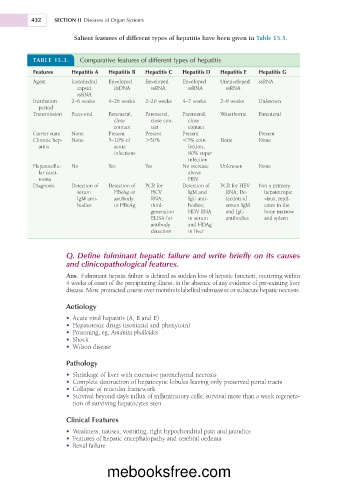
                        Salient	features	of	different	types	of	hepatitis	have	been	given	in	Table	15.3.


           TABLE 15.3.    Comparative features of different types of hepatitis
           Features    Hepatitis A  Hepatitis B  Hepatitis C  Hepatitis D  Hepatitis E   Hepatitis G
           Agent       Icosahedral   Enveloped   Enveloped   Enveloped   Unenveloped   ssRNA
                         capsid,    dsDNA      ssRNA       ssRNA       ssRNA
                         ssRNA
           Incubation   2–6 weeks  4–26 weeks  2–26 weeks  4–7 weeks  2–8 weeks  Unknown
             period
           Transmission  Feco-oral  Parenteral,   Parenteral,   Parenteral,   Waterborne  Parenteral
                                    close      close con-  close
                                    contact    tact        contact
           Carrier state  None    Present     Present    Present                 Present
           Chronic hep-  None     5–10% of    .50%       ,5% coin-   None        None
             atitis                 acute                  fection,
                                    infections             80% super
                                                           infection
           Hepatocellu-  No       Yes         Yes        No increase   Unknown   None
             lar carci-                                    above
             noma                                          HBV
           Diagnosis   Detection of   Detection of   PCR for   Detection of   PCR for HEV   Not a primary
                         serum      HBsAg or   HCV         IgM and     RNA; De-   hepatotropic
                         IgM anti-  antibody   RNA;        IgG anti-   tection of   virus; repli-
                         bodies     to HBcAg   third-      bodies;     serum IgM   cates in the
                                               generation   HDV RNA    and IgG    bone marrow
                                               ELISA for   in serum    antibodies  and spleen
                                               antibody    and HDAg
                                               detection   in liver


                     Q. Define fulminant hepatic failure and write briefly on its causes
                     and clinicopathological features.
                     Ans.  Fulminant hepatic failure is defined as sudden loss of hepatic function, occurring within
                     4 weeks of onset of the precipitating illness, in the absence of any evidence of pre-existing liver
                     disease. More protracted course over months is labelled submassive or subacute hepatic necrosis.

                     Aetiology
                     •	 Acute viral hepatitis (A, B and E)
                     •	 Hepatotoxic drugs (isoniazid and phenytoin)
                     •	 Poisoning, eg, Amanita phalloides
                     •	 Shock
                     •	 Wilson disease

                     Pathology
                     •	 Shrinkage of liver with extensive parenchymal necrosis
                     •	 Complete destruction of hepatocytic lobules leaving only preserved portal tracts
                     •	 Collapse of reticulin framework
                     •	 Survival beyond day’s influx of inflammatory cells; survival more than a week regenera-
                       tion of surviving hepatocytes seen

                     Clinical Features
                     •	 Weakness, nausea, vomiting, right hypochondrial pain and jaundice
                     •	 Features of hepatic encephalopathy and cerebral oedema
                     •	 Renal failure


                                  mebooksfree.com

