


Page 444 - Concise Pathology for Exam Preparation ( PDFDrive )
P. 444
15  Diseases of the Hepatobiliary System and Pancreas  429

             Acute Viral Hepatitis

             Acute viral hepatitis is further subdivided into the following clinical stages:
               1.  Incubation period.
               2.  Symptomatic preicteric phase: Also called prodromal phase, it lasts for a few days up to
                2 weeks before the onset of jaundice, and manifests with fever, headache, malaise, an-
                orexia, nausea, vomiting, diarrhoea, distaste for cigarettes and upper abdominal pain
                (due to stretching of liver capsule). Patients with HBV infection occasionally have a
                ‘serum sickness-like syndrome’ with skin rashes and polyarthralgia.
              3.  Symptomatic icteric phase: This is characterized by conjugated hyperbilirubinaemia with
                passage of dark urine and yellowish discolouration of the sclera. The constitutional symp-
                toms  diminish  with  the  onset  of  clinical  jaundice  when  the  patient  develops  tender
                hepatomegaly. With progressively increasing obstruction to biliary canaliculi, jaundice
                worsens, stools become paler, urine becomes darker and liver becomes more palpable
                (cholestatic phase). Icteric phase is seen in HAV infection, but is rare in HBV and HCV
                infections.
               4.  Convalescence or recovery phase: There is improvement in the gastrointestinal symp-
                toms; decrease in jaundice, normalization of stools and urine and decrease in the liver
                size. The clinical and biochemical recovery should be complete in 1–2 months from
                the onset in cases of hepatitis A and E and in 3–4 months from the onset in hepatitis
                B and C.
             Points to Remember
             Delta	coinfection is indistinguishable from acute hepatitis B, but delta	super	infection
               appears like an acute episode in a person chronically infected with HBV.
             Hepatitis B, D and E can result in fulminant hepatic failure. It is uncommon with hepatitis
               A and C. Pregnant women suffering from hepatitis E have a high incidence of fulminant
               hepatitis (20%).
             Anicteric	hepatitis is a mild illness with an anicteric course (no clinical jaundice).

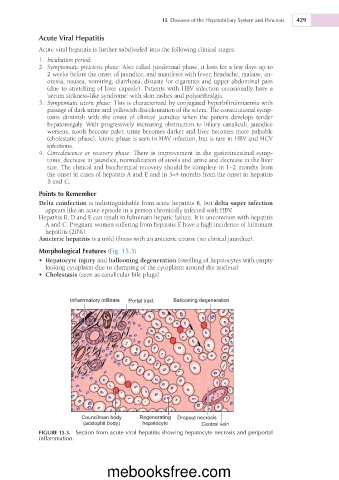
             Morphological Features (Fig. 15.3)
             •	 Hepatocyte injury and ballooning degeneration (swelling of hepatocytes with empty
               looking cytoplasm due to clumping of the cytoplasm around the nucleus)
             •	 Cholestasis (seen as canalicular bile plugs)


                       Inflammatory infiltrate  Portal tract  Ballooning degeneration


                          Councilman body   Regenerating  Dropout necrosis
                           (acidophil body)  hepatocyte        Central vein
             FIGURE 15.3.  Section from acute viral hepatitis showing hepatocyte necrosis and periportal
             inflammation.


                                  mebooksfree.com

