


Page 449 - Concise Pathology for Exam Preparation ( PDFDrive )
P. 449
434    SECTION II  Diseases of Organ Systems


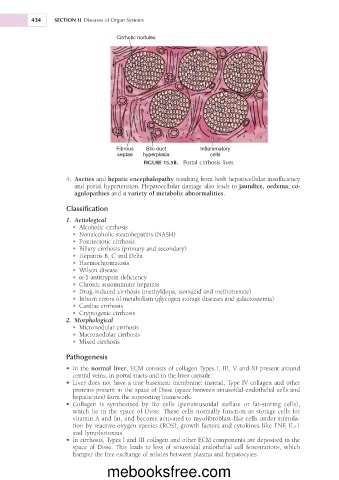
                                     Cirrhotic nodules


                                     Fibrous  Bile duct        Inflammatory
                                     septae  hyperplasia          cells
                                             FIGURE 15.5B.  Portal cirrhosis liver.


                       4.	 Ascites and hepatic	encephalopathy	resulting from both hepatocellular insufficiency
                        and portal hypertension. Hepatocellular damage also leads to jaundice,	oedema,	co-
                        agulopathies and	a	variety	of	metabolic	abnormalities.

                     Classification

                     1.  Aetiological
                       •	 Alcoholic cirrhosis
                       •	 Nonalcoholic steatohepatitis (NASH)
                       •	 Postnecrotic cirrhosis
                       •	 Biliary cirrhosis (primary and secondary)
                       •	 Hepatitis B, C and Delta
                       •	 Haemochromatosis
                       •	 Wilson disease
                       •	 a-1 antitrypsin deficiency
                       •	 Chronic autoimmune hepatitis
                       •	 Drug-induced cirrhosis (methyldopa, isoniazid and methotrexate)
                       •	 Inborn errors of metabolism (glycogen storage diseases and galactosaemia)
                       •	 Cardiac cirrhosis
                       •	 Cryptogenic cirrhosis
                     2.  Morphological
                       •	 Micronodular cirrhosis
                       •	 Macronodular cirrhosis
                       •	 Mixed cirrhosis

                     Pathogenesis
                     •	 In the normal	liver, ECM consists of collagen Types I, III, V and XI present around
                       central veins, in portal tracts and in the liver capsule.
                     •	 Liver does not have a true basement membrane; instead, Type IV collagen and other
                       proteins present in the space of Disse (space between sinusoidal endothelial cells and
                       hepatocytes) form the supporting framework.
                     •	 Collagen  is  synthesized  by  Ito  cells  (perisinusoidal  stellate  or  fat-storing  cells),
                       which lie in the space of Disse. These cells normally function as storage cells for
                       vitamin A and fat, and become activated to myofibroblast-like cells under stimula-
                       tion by reactive oxygen species (ROS), growth factors and cytokines like TNF, IL-1
                       and lymphotoxins.
                     •	 In cirrhosis, Types I and III collagen and other ECM components are deposited in the
                       space of Disse. This leads to loss of sinusoidal endothelial cell fenestrations, which
                       hamper the free exchange of solutes between plasma and hepatocytes.

                                  mebooksfree.com

