


Page 499 - Concise Pathology for Exam Preparation ( PDFDrive )
P. 499
484    SECTION II  Diseases of Organ Systems


           TABLE 16.12.    Clinicopathological features of the most common types of RCC—cont’d

                                                                Collecting duct
                                                  Chromophobe   (Bellini duct)   Xp11 transloca-
           Features  Clear-cell RCC  Papillary RCC  RCC         carcinoma     tion carcinoma
           Gross     •  Solitary, unilat-  Multifocal, bilat-  •  Tan brown  Seen in medullary  -
                      eral, bright yel-  eral, less yellow   •  Excellent   region
                      low to grey-   due to lower   prognosis
                      white with     lipid content,
                      prominent cys-  papillae may be
                      tic change and   seen, haemor-
                      haemorrhage    rhagic and cys-
                     •  Aggressive; may   tic areas present
                      infiltrate into
                      surrounding
                      substance, col-
                      lecting system,
                      calyces, ureters
                      and renal vein
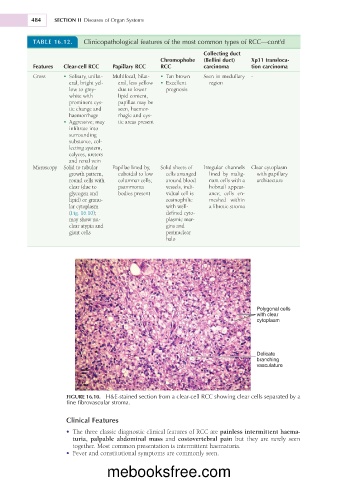
           Microscopy  Solid to tubular   Papillae lined by,   Solid sheets of   Irregular  channels  Clear cytoplasm
                      growth pattern,   cuboidal to low   cells arranged   lined  by  malig-  with papillary
                      round cells with   columnar cells;   around blood   nant cells with a   architecture
                      clear (due to   psammoma      vessels, indi-  hobnail  appear-
                      glycogen and   bodies present  vidual cell is   ance;  cells  en-
                      lipid) or granu-              eosinophilic   meshed  within
                      lar cytoplasm                 with well-   a fibrotic stroma
                      (Fig. 16.10);                 defined cyto-
                      may show nu-                  plasmic mar-
                      clear atypia and              gins and
                      giant cells                   perinuclear
                                                    halo


                                                                                Polygonal cells
                                                                                with clear
                                                                                cytoplasm


                                                                                Delicate
                                                                                branching
                                                                                vasculature


                     FIGURE 16.10.  H&E-stained section from a clear-cell RCC showing clear cells separated by a
                     fine fibrovascular stroma.

                     Clinical Features
                     •  The three classic diagnostic clinical features of RCC are painless intermittent haema-
                       turia,  palpable  abdominal  mass  and  costovertebral  pain  but  they  are  rarely  seen
                       together. Most common presentation is intermittent haematuria.
                     •  Fever and constitutional symptoms are commonly seen.


                                  mebooksfree.com

