


Page 498 - Concise Pathology for Exam Preparation ( PDFDrive )
P. 498
16  Diseases of the Kidney and Lower Urinary Tract  483


             •  Also called ‘hypernephroma’ due to resemblance to clear cells of adrenal cortex and
               gross yellow colour
             •  Arises from tubular epithelium (renal adenocarcinomas)

             Epidemiology
             •  Predisposing  factors:  Smoking,  obesity,  hypertension,  unopposed  oestrogen  therapy,
               exposure to asbestos, cadmium, petroleum products and heavy metals and acquired
               cystic disease in patients with long-standing dialysis.
             •  Majority of cases of RCC are sporadic; about 5% are inherited and associated with:
                1.  von Hippel–Lindau (VHL) syndrome: Predisposition to a large number of neo-
                  plasms, mainly haemangioblastomas of cerebellum and retina, multiple bilateral
                  renal cysts, pheochromocytomas and multicentric bilateral renal cell carcinomas.
                2.  Hereditary  leiomyomatosis  and  renal  cell  cancer  syndrome:  Autosomal  dominant
                  inheritance; mutation in Fumarate Hydratase (FH) gene; associated with uterine and
                  cutaneous leiomyomas and an aggressive variety of papillary RCC.
                3.  Hereditary  papillary  RCC:  Autosomal  dominant  inheritance;  multiple  cytogenetic
                  abnormalities; mutation in MET proto-oncogene; associated with multiple bilateral
                  papillary RCCs.
                4.  Birt–Hogg–Dube (BHD) syndrome: Autosomal dominant inheritance; mutation in BHD
                  gene (expresses folliculin); associated with skin appendageal tumours of hair follicular
                  origin, pulmonary cysts and renal tumours.
             Gross Morphology

             •  Globular,  encapsulated,  3–5  cm,  soft,  lobulated  with  a  variegated  appearance
               (grey-white to yellow with necrosis, haemorrhage and cyst formation); invades or grows
               into pelvis.
             •  Polar in distribution; the upper pole is more commonly involved than the lower pole.
             •  Renal vascular invasion is common.
             •  Usually  sharply  defined;  however,  small  satellite  nodules  are  often  found  in  the
               surrounding substance.
             •  Enlarges n bulges into pelvis and calyces n fungates through walls of collecting system
               n ureters.
             •  Penetrates through capsule n invades perinephric fat and adrenals.
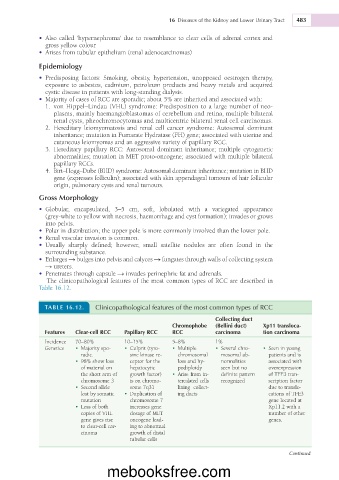
               The clinicopathological features of the most common types of RCC are described in
             Table 16.12.

               TABLE 16.12.   Clinicopathological features of the most common types of RCC

                                                                   Collecting duct
                                                      Chromophobe   (Bellini duct)   Xp11 transloca-
               Features  Clear-cell RCC  Papillary RCC  RCC        carcinoma      tion carcinoma
               Incidence  70–80%       10–15%         5–8%         1%
               Genetics  •  Majority spo-  •  Culprit (tyro-  •  Multiple   •  Several chro-  •  Seen in young
                          radic.         sine kinase re-  chromosomal   mosomal ab-  patients and is
                        •  98% show loss   ceptor for the   loss and hy-  normalities   associated with
                          of material on   hepatocytic   podiploidy  seen but no    overexpression
                          the short arm of   growth factor)   •  Arise from in-  definite pattern   of TFE3 tran-
                          chromosome 3   is on chromo-  tercalated cells   recognized  scription factor
                        •  Second allele   some 7q31    lining  collect-            due to translo-
                          lost by somatic   •  Duplication of   ing ducts           cations of TFE3
                          mutation       chromosome 7                               gene located at
                        •  Loss of both   increases gene                            Xp11.2 with a
                          copies of VHL   dosage of MET                             number of other
                          gene gives rise   oncogene lead-                          genes.
                          to clear-cell car-  ing to abnormal
                          cinoma         growth of distal
                                         tubular cells

                                                                                          Continued

                                  mebooksfree.com

