


Page 497 - Concise Pathology for Exam Preparation ( PDFDrive )
P. 497
482    SECTION II  Diseases of Organ Systems


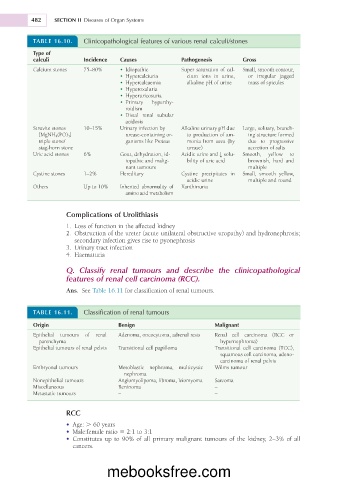
           TABLE 16.10.    Clinicopathological features of various renal calculi/stones

           Type of
           calculi         Incidence   Causes            Pathogenesis       Gross
           Calcium stones  75–80%     •  Idiopathic      Super saturation of cal-  Small, smooth contour,
                                      •  Hypercalciuria    cium  ions  in  urine,   or  irregular  jagged
                                      •  Hypercalcaemia    alkaline pH of urine  mass of spicules
                                      •  Hyperoxaluria
                                      •  Hyperuricosuria
                                      •  Primary   hyperthy-
                                        roidism
                                      •  Distal  renal  tubular
                                        acidosis
           Struvite stones   10–15%   Urinary infection by   Alkaline urinary pH due   Large, solitary, branch-
             [MgNH 4 (PO) 3 ]           urease-containing or-  to production of am-  ing structure formed
             triple stone/              ganisms like Proteus  monia from urea (by   due  to  progressive
             stag-horn stone                               urease)           accretion of salts
           Uric acid stones  6%       Gout, dehydration, id-  Acidic urine and g solu-  Smooth,   yellow   to
                                        iopathic and malig-  bility of uric acid  brownish,  hard  and
                                        nant tumours                         multiple
           Cystine stones  1–2%       Hereditary         Cystine  precipitates  in   Small,  smooth  yellow,
                                                           acidic urine      multiple and round
           Others          Up to 10%   Inherited  abnormality  of   Xanthinuria
                                        amino acid metabolism


                     Complications of Urolithiasis

                       1.  Loss of function in the affected kidney
                       2.  Obstruction of the ureter (acute unilateral obstructive uropathy) and hydronephrosis;
                        secondary infection gives rise to pyonephrosis
                       3.  Urinary tract infection
                       4.  Haematuria

                     Q.  Classify  renal  tumours  and  describe  the  clinicopathological
                     features of renal cell carcinoma (RCC).
                     Ans.  See Table 16.11 for classification of renal tumours.


           TABLE 16.11.    Classification of renal tumours

           Origin                    Benign                        Malignant
           Epithelial  tumours  of  renal     Adenoma, oncocytoma, adrenal rests  Renal  cell  carcinoma  (RCC  or
             parenchyma                                              hypernephroma)
           Epithelial tumours of renal pelvis  Transitional cell papilloma  Transitional  cell  carcinoma  (TCC),
                                                                     squamous cell carcinoma, adeno-
                                                                     carcinoma of renal pelvis
           Embryonal tumours         Mesoblastic  nephroma,  multicystic   Wilms tumour
                                       nephroma
           Nonepithelial tumours     Angiomyolipoma, fibroma, leiomyoma  Sarcoma
           Miscellaneous             Reninoma                      –
           Metastatic tumours        –                             –

                     RCC

                     •  Age: . 60 years
                     •  Male:female ratio 5 2:1 to 3:1
                     •  Constitutes up to 90% of all primary malignant tumours of the kidney, 2–3% of all
                       cancers.


                                  mebooksfree.com

