


Page 534 - Concise Pathology for Exam Preparation ( PDFDrive )
P. 534
18  Female Genital System  519

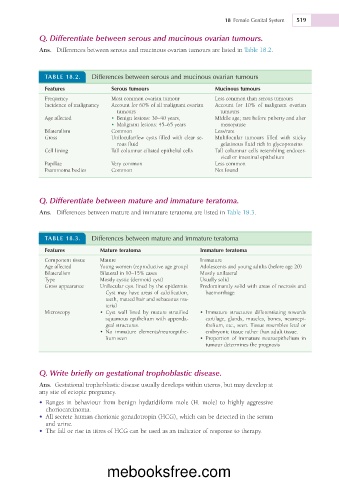
             Q. Differentiate between serous and mucinous ovarian tumours.

             Ans.   Differences between serous and mucinous ovarian tumours are listed in Table 18.2.


               TABLE 18.2.   Differences between serous and mucinous ovarian tumours
               Features            Serous tumours                  Mucinous tumours
               Frequency           Most common ovarian tumour      Less common than serous tumours
               Incidence of malignancy  Account for 60% of all malignant ovarian   Account  for  10%  of  malignant  ovarian
                                     tumours                         tumours
               Age affected        •  Benign lesions: 30–40 years,  Middle age; rare before puberty and after
                                   •  Malignant lesions: 45–65 years  menopause
               Bilateralism        Common                          Less/rare
               Gross               Unilocular/few cysts filled with clear se-  Multilocular  tumours  filled  with  sticky
                                     rous fluid                      gelatinous fluid rich in glycoproteins
               Cell lining         Tall columnar ciliated epithelial cells  Tall columnar cells resembling endocer-
                                                                     vical or intestinal epithelium
               Papillae            Very common                     Less common
               Psammoma bodies     Common                          Not found


             Q. Differentiate between mature and immature teratoma.
             Ans.   Differences between mature and immature teratoma are listed in Table 18.3.


               TABLE 18.3.   Differences between mature and immature teratoma

               Features         Mature teratoma                Immature teratoma
               Component tissue  Mature                        Immature
               Age affected     Young women (reproductive age group)  Adolescents and young adults (before age 20)
               Bilateralism     Bilateral in 10–15% cases      Mostly unilateral
               Type             Mostly cystic (dermoid cyst)   Usually solid
               Gross appearance  Unilocular cyst lined by the epidermis.   Predominantly solid with areas of necrosis and
                                  Cyst may have areas of calcification,   haemorrhage
                                  teeth, matted hair and sebaceous ma-
                                  terial
               Microscopy       •  Cyst  wall  lined  by  mature  stratified   •  Immature  structures  differentiating  towards
                                  squamous epithelium with appenda-  cartilage,  glands,  muscles,  bones,  neuroepi-
                                  geal structures.              thelium, etc., seen. Tissue resembles fetal or
                                •  No  immature  elements/neuroepithe-  embryonic tissue rather than adult tissue.
                                  lium seen                    •  Proportion  of  immature  neuroepithelium  in
                                                                tumour determines the prognosis


             Q. Write briefly on gestational trophoblastic disease.
             Ans.  Gestational trophoblastic disease usually develops within uterus, but may develop at
             any site of ectopic pregnancy.
             •  Ranges  in  behaviour  from  benign  hydatidiform  mole  (H.  mole)  to  highly  aggressive
               choriocarcinoma.
             •  All secrete human chorionic gonadotropin (HCG), which can be detected in the serum
               and urine.
             •  The fall or rise in titres of HCG can be used as an indicator of response to therapy.


                                  mebooksfree.com

