


Page 532 - Concise Pathology for Exam Preparation ( PDFDrive )
P. 532
18  Female Genital System  517


                   •  Majority are unilateral, solid large tumours showing sheets and nests of cells with clear
                     cytoplasm and well-defined cytoplasmic margins, separated by thin fibrous strands.
                     Stroma contains lymphoid cells and may show granulomatous inflammation.
                   •  Radio responsive with 80% survival.
                 (b)  Teratoma:  Constitutes 15–20% of ovarian tumours; more than 90% are benign mature
                   cystic teratomas. Other types include immature, malignant and specialized teratomas.
                    (i)  Benign mature cystic teratomas
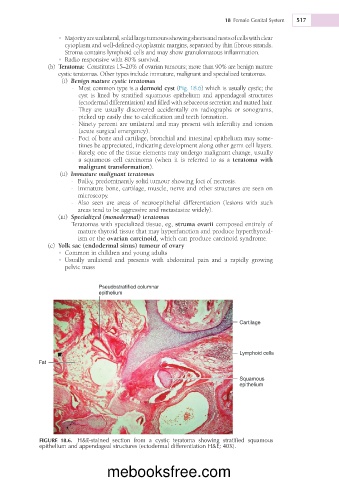
                       -  Most common type is a dermoid cyst (Fig. 18.6) which is usually cystic; the
                         cyst  is  lined  by  stratified  squamous  epithelium  and  appendageal  structures
                         (ectodermal differentiation) and filled with sebaceous secretion and matted hair.
                       -  They  are  usually  discovered  accidentally  on  radiographs  or  sonograms,
                         picked up easily due to calcification and teeth formation.
                       -  Ninety percent are unilateral and may present with infertility and torsion
                         (acute surgical emergency).
                       -  Foci of bone and cartilage, bronchial and intestinal epithelium may some-
                         times be appreciated, indicating development along other germ cell layers.
                       -  Rarely, one of the tissue elements may undergo malignant change, usually
                         a  squamous  cell  carcinoma  (when  it  is  referred  to  as  a  teratoma  with
                         malignant transformation).
                   (ii)  Immature malignant teratomas
                       -  Bulky, predominantly solid tumour showing foci of necrosis.
                       -  Immature bone, cartilage, muscle, nerve and other structures are seen on
                         microscopy.
                       -  Also  seen  are  areas  of  neuroepithelial  differentiation  (lesions  with  such
                         areas tend to be aggressive and metastasize widely).
                   (iii)  Specialized (monodermal) teratomas
                       Teratomas with specialized tissue, eg, struma ovarii composed entirely of
                         mature thyroid tissue that may hyperfunction and produce hyperthyroid-
                         ism or the ovarian carcinoid, which can produce carcinoid syndrome.
                 (c)  Yolk sac (endodermal sinus) tumour of ovary
                   •  Common in children and young adults
                   •  Usually  unilateral  and  presents  with  abdominal  pain  and  a  rapidly  growing
                     pelvic mass

                               Pseudostratified columnar
                               epithelium


                                                                           Cartilage


                                                                           Lymphoid cells
             Fat

                                                                           Squamous
                                                                           epithelium


             FIGURE  18.6.  H&E-stained  section  from  a  cystic  teratoma  showing  stratified  squamous
             epithelium and appendageal structures (ectodermal differentiation H&E; 40X).


                                  mebooksfree.com

