


Page 537 - Concise Pathology for Exam Preparation ( PDFDrive )
P. 537
19


                     The Breast


                     •	 Breast is a modified apocrine gland, which is composed of 6–10 major ductal systems that
                       can be traced from the nipple (keratinizing stratified squamous epithelium of the skin
                       continues into the ducts and abruptly changes into double-layered cuboidal epithelium).
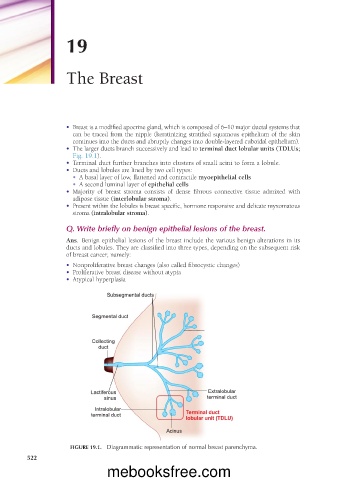
                     •	 The larger ducts branch successively and lead to terminal	duct	lobular	units	(TDLUs;
                       Fig. 19.1).
                     •	 Terminal duct further branches into clusters of small acini to form a lobule.
                     •	 Ducts and lobules are lined by two cell types:
                       •	 A basal layer of low, flattened and contractile myoepithelial	cells
                       •	 A second luminal layer of epithelial	cells
                     •	 Majority  of  breast  stroma  consists  of  dense  fibrous  connective  tissue  admixed  with
                       adipose tissue (interlobular	stroma).
                     •	 Present within the lobules is breast specific, hormone responsive and delicate myxomatous
                       stroma (intralobular	stroma).

                     Q. Write briefly on benign epithelial lesions of the breast.

                     Ans.  Benign epithelial lesions of the breast include the various benign alterations in its
                     ducts and lobules. They are classified into three types, depending on the subsequent risk
                     of breast cancer, namely:
                     •	 Nonproliferative breast changes (also called fibrocystic changes)
                     •	 Proliferative breast disease without atypia
                     •	 Atypical hyperplasia


                       FIGURE 19.1.  Diagrammatic representation of normal breast parenchyma.
         522

                                  mebooksfree.com

