


Page 535 - Concise Pathology for Exam Preparation ( PDFDrive )
P. 535
520    SECTION II  Diseases of Organ Systems

                     H. Mole

                     •  Traditionally discovered during 12–14 weeks of pregnancy.
                     •  Uterine enlargement is more than what is anticipated for that period of gestation.
                     •  Manifests with vaginal bleeding and passage of grape-like tissue mass.
                     •  Elevation of HCG (particularly the beta subunit) in blood and urine and absence of fetal
                       parts or fetal heart sound on sonography is diagnostic.
                     •  It is of two types, namely, complete and partial mole.
                     Gross Morphology
                     •  Uterine cavity/ectopic site is filled with delicate, friable masses of thin-walled, translucent,
                       cystic and grape-like structures.
                     •  Amniotic sac is very small and collapsed.
                     •  No fetal parts in complete mole; may be seen in partial mole.
                     Microscopic Examination
                     •  Complete mole
                       •  All villi show hydropic swelling and complete loss of vascularity.
                       •  The central substance of the villi is loose, myxomatous and oedematous, covered by
                         a layer of chorionic epithelium (cytotrophoblast and syncytiotrophoblast).
                       •  Villi show circumferential proliferation of epithelium to produce sheets and masses of
                         the same.
                     •  Partial mole
                       •  Villous oedema restricted to some villi.
                       •  Trophoblastic proliferation is mild and focal.
                       •  Villi have a characteristic irregular scalloped margin.

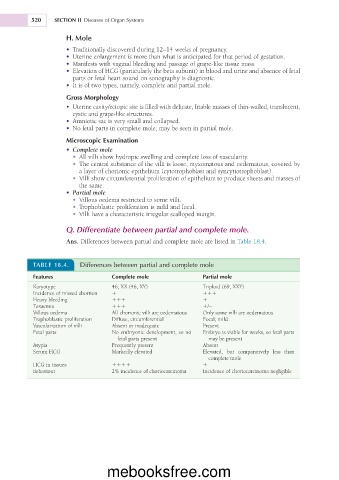
                     Q. Differentiate between partial and complete mole.

                     Ans. Differences between partial and complete mole are listed in Table 18.4.


           TABLE 18.4.    Differences between partial and complete mole
           Features                Complete mole               Partial mole
           Karyotype               46, XX (46, XY)             Triploid (69, XXY)
           Incidence of missed abortion   1                    111
           Heavy bleeding          111                         1
           Toxaemia                111                         1/–
           Villous oedema          All chorionic villi are oedematous  Only some villi are oedematous
           Trophoblastic proliferation  Diffuse; circumferential  Focal; mild
           Vascularization of villi  Absent or inadequate      Present
           Fetal parts             No embryonic development, so no   Embryo is viable for weeks, so fetal parts
                                     fetal parts present         may be present
           Atypia                  Frequently present          Absent
           Serum HCG               Markedly elevated           Elevated,  but  comparatively  less  than
                                                                 complete mole
           HCG in tissues          1111                        1
           Behaviour               2% incidence of choriocarcinoma  Incidence of choriocarcinoma negligible


                                  mebooksfree.com

