


Page 560 - Concise Pathology for Exam Preparation ( PDFDrive )
P. 560
20  Endocrinology  545


               6.  Adenoma with papillae
               7.  Clear cell and signet-ring adenoma

             Q. Differentiate between an adenomatous nodule and a follicular
             adenoma.

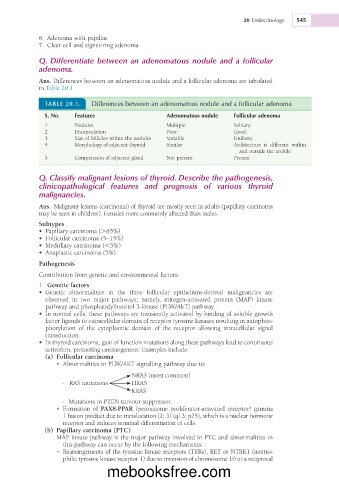
             Ans. Differences between an adenomatous nodule and a follicular adenoma are tabulated
             in Table 20.1.

               TABLE 20.1.   Differences between an adenomatous nodule and a follicular adenoma

               S. No.   Features                    Adenomatous nodule   Follicular adenoma
               1        Nodules                     Multiple             Solitary
               2        Encapsulation               Poor                 Good
               3        Size of follicles within the nodules  Variable   Uniform
               4        Morphology of adjacent thyroid  Similar          Architecture  is  different  within
                                                                           and outside the nodule
               5        Compression of adjacent gland  Not present       Present

             Q. Classify malignant lesions of thyroid. Describe the pathogenesis,
             clinicopathological  features  and  prognosis  of  various  thyroid
             malignancies.

             Ans.	 Malignant lesions (carcinoma) of thyroid are mostly seen in adults (papillary carcinoma
             may be seen in children). Females more commonly affected than males.
             Subtypes
             •	 Papillary carcinoma (.85%)
             •	 Follicular carcinoma (5–15%)
             •	 Medullary carcinoma (,5%)
             •	 Anaplastic carcinoma (5%)
             Pathogenesis
             Contribution from genetic and environmental factors:
               1.  Genetic	factors
             •	 Genetic  abnormalities  in  the  three  follicular  epithelium-derived  malignancies  are
               observed  in  two  major  pathways;  namely,  mitogen-activated  protein  (MAP)  kinase
               pathway and phosphatidylinositol 3-kinase (PI3K/AkT) pathway.
             •	 In normal cells, these pathways are transiently activated by binding of soluble growth
               factor ligands to extracellular domain of receptor tyrosine kinases resulting in autophos-
               phorylation  of  the  cytoplasmic  domain  of  the  receptor  allowing  intracellular  signal
               transduction.
             •	 In thyroid carcinoma, gain of function mutations along these pathways lead to continuous
               activation, promoting carcinogenesis. Examples include:
             	 (a)	 Follicular	carcinoma
                  •	 Abnormalities in PI3K/AKT signalling pathway due to:
                                         NRAS (most common)
                    -   RAS mutations     HRAS
                                         KRAS
                    -  Mutations in PTEN tumour suppressor.
                  •	 Formation  of  PAX8-PPAR  (peroxisome  proliferator-activated  receptor)  gamma
                    1 fusion product due to translocation (2; 3) (q13; p25), which is a nuclear hormone
                    receptor and induces terminal differentiation of cells.
             	 (b)	 Papillary	carcinoma	(PTC)
                  MAP kinase pathway is the major pathway involved in PTC and abnormalities in
                    this pathway can occur by the following mechanisms:
                  •  Rearrangements of the tyrosine kinase receptors (TKRs), RET or NTRK1 (neutro-
                    philic tyrosine kinase receptor 1) due to inversion of chromosome 10 or a reciprocal
                                  mebooksfree.com

