


Page 581 - Concise Pathology for Exam Preparation ( PDFDrive )
P. 581
566    SECTION II  Diseases of Organ Systems


                       8.  Polycystic ovarian disease or acanthosis nigricans
                       9.  History of vascular disease

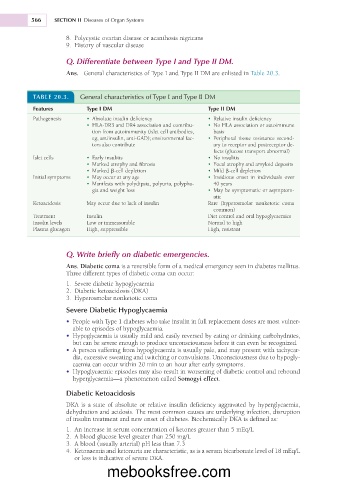
                     Q. Differentiate between Type I and Type II DM.
                     Ans.	  General characteristics of Type I and Type II DM are enlisted in Table 20.3.


           TABLE 20.3.    General characteristics of Type I and Type II DM
           Features         Type I DM                            Type II DM
           Pathogenesis     •  Absolute insulin deficiency       •  Relative insulin deficiency
                            •  HLA-DR3 and DR4 association and contribu-  •  No HLA association or autoimmune
                             tion from autoimmunity (islet cell antibodies,   basis
                             eg, antiinsulin, anti-GAD); environmental fac-  •  Peripheral  tissue  resistance  second-
                             tors also contribute                  ary to receptor and postreceptor de-
                                                                   fects (glucose transport abnormal)
           Islet cells      •  Early insulitis                   •  No insulitis
                            •  Marked atrophy and fibrosis       •  Focal atrophy and amyloid deposits
                            •  Marked b-cell depletion           •  Mild b-cell depletion
           Initial symptoms  •  May occur at any age             •  Insidious  onset  in  individuals  over
                            •  Manifests with polydipsia, polyuria, polypha-  40 years
                             gia and weight loss                 •  May be symptomatic or asymptom-
                                                                   atic
           Ketoacidosis     May occur due to lack of insulin     Rare  (hyperosmolar  nonketotic  coma
                                                                   common)
           Treatment        Insulin                              Diet control and oral hypoglycaemics
           Insulin levels   Low or immeasurable                  Normal to high
           Plasma glucagon  High, suppressible                   High, resistant


                     Q. Write briefly on diabetic emergencies.
                     Ans.	Diabetic	coma is a reversible form of a medical emergency seen in diabetes mellitus.
                     Three different types of diabetic coma can occur:
                       1.  Severe diabetic hypoglycaemia
                       2.  Diabetic ketoacidosis (DKA)
                       3.  Hyperosmolar nonketotic coma
                     Severe Diabetic Hypoglycaemia
                     •	 People with Type 1 diabetes who take insulin in full replacement doses are most vulner-
                       able to episodes of hypoglycaemia.
                     •	 Hypoglycaemia is usually mild and easily reversed by eating or drinking carbohydrates,
                       but can be severe enough to produce unconsciousness before it can even be recognized.
                     •	 A person suffering from hypoglycaemia is usually pale, and may present with tachycar-
                       dia, excessive sweating and twitching or convulsions. Unconsciousness due to hypogly-
                       caemia can occur within 20 min to an hour after early symptoms.
                     •	 Hypoglycaemic episodes may also result in worsening of diabetic control and rebound
                       hyperglycaemia—a phenomenon called Somogyi	effect.

                     Diabetic Ketoacidosis
                     DKA is a state of absolute or relative insulin deficiency aggravated by hyperglycaemia,
                     dehydration and acidosis. The most common causes are underlying infection, disruption
                     of insulin treatment and new onset of diabetes. Biochemically DKA is defined as:
                       1.  An increase in serum concentration of ketones greater than 5 mEq/L
                       2.  A blood glucose level greater than 250 mg/L
                       3.  A blood (usually arterial) pH less than 7.3
                      4.  Ketonaemia and ketonuria are characteristic, as is a serum bicarbonate level of 18 mEq/L
                        or less is indicative of severe DKA.

                                  mebooksfree.com

