


Page 583 - Concise Pathology for Exam Preparation ( PDFDrive )
P. 583
568    SECTION II  Diseases of Organ Systems

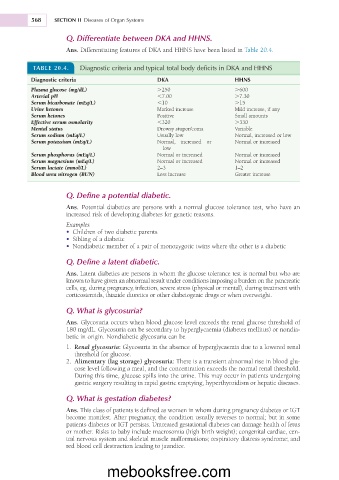
                     Q. Differentiate between DKA and HHNS.

                     Ans. Differentiating features of DKA and HHNS have been listed in Table 20.4.

           TABLE 20.4.    Diagnostic criteria and typical total body deficits in DKA and HHNS

           Diagnostic criteria                   DKA                     HHNS
           Plasma glucose (mg/dL)                .250                    .600
           Arterial pH                           ,7.00                   .7.30
           Serum bicarbonate (mEq/L)             ,10                     .15
           Urine ketones                         Marked increase         Mild increase, if any
           Serum ketones                         Positive                Small amounts
           Effective serum osmolarity            ,320                    .330
           Mental status                         Drowsy stupor/coma      Variable
           Serum sodium (mEq/L)                  Usually low             Normal, increased or low
           Serum potassium (mEq/L)               Normal,  increased  or   Normal or increased
                                                   low
           Serum phosphorus (mEq/L)              Normal or increased     Normal or increased
           Serum magnesium (mEq/L)               Normal or increased     Normal or increased
           Serum lactate (mmol/L)                2–3                     1–2
           Blood urea nitrogen (BUN)             Less increase           Greater increase


                     Q. Define a potential diabetic.
                     Ans.	 Potential diabetics are persons with a normal glucose tolerance test, who have an
                     increased risk of developing diabetes for genetic reasons.
                     Examples
                     •	 Children of two diabetic parents
                     •	 Sibling of a diabetic
                     •	 Nondiabetic member of a pair of monozygotic twins where the other is a diabetic
                     Q. Define a latent diabetic.

                     Ans. Latent diabetics are persons in whom the glucose tolerance test is normal but who are
                     known to have given an abnormal result under conditions imposing a burden on the pancreatic
                     cells, eg, during pregnancy, infection, severe stress (physical or mental), during treatment with
                     corticosteroids, thiazide diuretics or other diabetogenic drugs or when overweight.

                     Q. What is glycosuria?
                     Ans. Glycosuria occurs when blood glucose level exceeds the renal glucose threshold of
                     180 mg/dL. Glycosuria can be secondary to hyperglycaemia (diabetes mellitus) or nondia-
                     betic in origin. Nondiabetic glycosuria can be
                       1.  Renal glycosuria: Glycosuria in the absence of hyperglycaemia due to a lowered renal
                        threshold for glucose.
                       2.  Alimentary	(lag	storage)	glycosuria: There is a transient abnormal rise in blood glu-
                        cose level following a meal, and the concentration exceeds the normal renal threshold.
                        During this time, glucose spills into the urine. This may occur in patients undergoing
                        gastric surgery resulting in rapid gastric emptying, hyperthyroidism or hepatic diseases.

                     Q. What is gestation diabetes?
                     Ans. This class of patients is defined as women in whom during pregnancy diabetes or IGT
                     become manifest. After pregnancy, the condition usually reverses to normal; but in some
                     patients diabetes or IGT persists. Untreated gestational diabetes can damage health of fetus
                     or mother. Risks to baby include macrosomia (high birth weight); congenital cardiac, cen-
                     tral nervous system and skeletal muscle malformations; respiratory distress syndrome; and
                     red blood cell destruction leading to jaundice.


                                  mebooksfree.com

