


Page 585 - Concise Pathology for Exam Preparation ( PDFDrive )
P. 585
570    SECTION II  Diseases of Organ Systems


                                           Spongy
                                           bone


                                          Epiphysis


                                      Epiphyseal plate


                                          Compact
                                           bone


                                         Diaphysis


                                         Metaphysis


                                                                     Secondary
                                                                     ossification
                                                                       centre
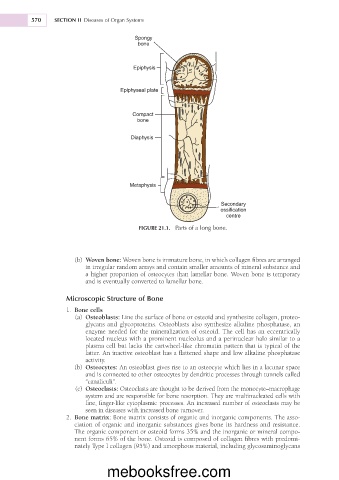
                                            FIGURE 21.1.  Parts of a long bone.


                         (b)  Woven	bone:	Woven bone is immature bone, in which collagen fibres are arranged
                           in irregular random arrays and contain smaller amounts of mineral substance and
                           a higher proportion of osteocytes than lamellar bone. Woven bone is temporary
                           and is eventually converted to lamellar bone.

                     Microscopic Structure of Bone

                       1.  Bone	cells
                         (a)  Osteoblasts:	Line the surface of bone or osteoid and synthesize collagen, proteo-
                           glycans and glycoproteins. Osteoblasts also synthesize alkaline phosphatase, an
                           enzyme needed for the mineralization of osteoid. The cell has an eccentrically
                           located nucleus with a prominent nucleolus and a perinuclear halo similar to a
                           plasma cell but lacks the cartwheel-like chromatin pattern that is typical of the
                           latter. An inactive osteoblast has a flattened shape and low alkaline phosphatase
                           activity.
                         (b)  Osteocytes:	An osteoblast gives rise to an osteocyte which lies in a lacunar space
                           and is connected to other osteocytes by dendritic processes through tunnels called
                           “canaliculi”.
                         (c)  Osteoclasts: Osteoclasts are thought to be derived from the monocyte–macrophage
                           system and are responsible for bone resorption. They are multinucleated cells with
                           fine, finger-like cytoplasmic processes. An increased number of osteoclasts may be
                           seen in diseases with increased bone turnover.
                       2.  Bone	matrix: Bone matrix consists of organic and inorganic components. The asso-
                        ciation of organic and inorganic substances gives bone its hardness and resistance.
                        The organic component or osteoid forms 35% and the inorganic or mineral compo-
                        nent forms 65% of the bone. Osteoid is composed of collagen fibres with predomi-
                        nately Type I collagen (95%) and amorphous material, including glycosaminoglycans


                                  mebooksfree.com

