


Page 586 - Concise Pathology for Exam Preparation ( PDFDrive )
P. 586
21  Musculoskeletal System  571


                that are associated with proteins like osteopontin. The inorganic part is constituted
                by hydroxyapatite which serves as a reservoir for calcium.


             Q. Define and classify osteomyelitis.
             Ans.  Osteomyelitis is defined as infection of the bone (osteo) and marrow (myelo) by
             bacteria, viruses or fungi.


             Classification
               1.  Pyogenic	(bacterial)	osteomyelitis:
                •	 Most frequently targets children and young adults.
                •	 Occurs due to haematogenous spread; extension from a contiguous site of infection,
                  eg, cellulitis or direct implantation.
                •	 Common  causative  organisms  include  Staphylococcus  aureus  (in  80–90%  cases)
                  followed by E. coli, Pseudomonas, Klebsiella, Haemophilus influenzae and Salmonella.
                  Mixed infections are also seen.
                •	 The most frequent sites of involvement are the areas of rapid growth (distal femur,
                  proximal tibia, proximal humerus and distal radius).
                •	 Location of infection is influenced by the vascular circulation. The slowing or  sludg-
                  ing of blood flow as the vessels make sharp angles at the metaphyses predisposes the
                  vessels to thrombosis and the bone itself to localized necrosis and bacterial seeding.
                •	 In the presence of bacterial infection elsewhere, a site of thrombosis acts as a nidus
                  for bacterial growth and development of osteomyelitis.
                •	 Trauma  is  an  important  predisposing  factor  for  osteomyelitis  because  it  aids  in
                  venostasis and thrombosis.
             Stages of infection:
               •	 Acute	(develops over days and weeks)
               •	 Chronic	(develops over weeks to months; may persist for years)
             Pathology:
             Acute  followed  by  chronic  inflammatory  cells  are  seen  surrounding  fragments  of  dead
               bone. Occasionally foreign body giant cell reaction may be seen (Fig 21.3). The dead
               bone shows empty lacunae without osteocytes.
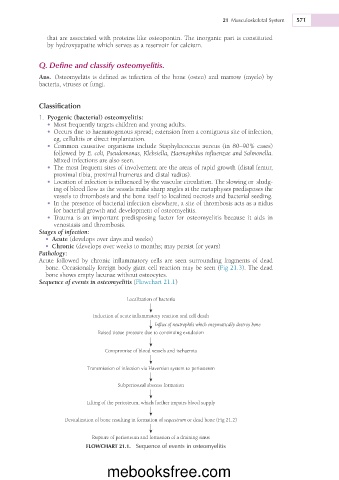
             Sequence of events in osteomyelitis (Flowchart 21.1)

                                        Localization of bacteria

                              Induction of acute inflammatory reaction and cell death
                                                 Influx of neutrophils which enzymatically destroy bone
                               Raised tissue pressure due to continuing exudation


                                 Compromise of blood vessels and ischaemia

                            Transmission of infection via Haversian system to periosteum


                                     Subperiosteal abscess formation

                            Lifting of the periosteum, which further impairs blood supply

                     Devitalization of bone resulting in formation of sequestrum or dead bone (Fig 21.2)


                             Rupture of periosteum and formation of a draining sinus
                           FLOWCHART 21.1.  Sequence of events in osteomyelitis


                                  mebooksfree.com

