


Page 610 - Concise Pathology for Exam Preparation ( PDFDrive )
P. 610
21  Musculoskeletal System  595


                   Genetic and biochemical factors  Chondrocyte injury

                                                    IL-1, TNF


                                    Catabolic metalloproteinases (collagenase and stromelysin)


                                             Destroy articular cartilage matrix
                                         (fibrillation and erosion of cartilage surface)
                                                         Release of proteoglycan and collagen
                                                         fragments into the synovial fluid
                                     Exposed subchondral bone becomes new articular surface


                                              Bone surface resembles ivory
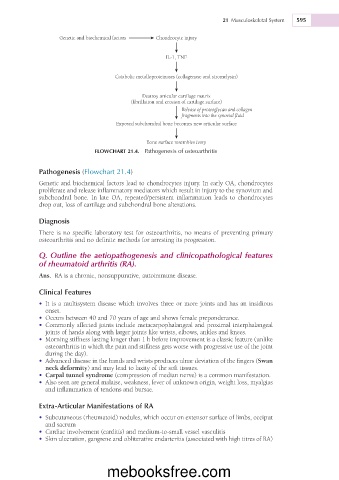
                              FLOWCHART 21.4.  Pathogenesis of osteoarthritis


             Pathogenesis (Flowchart 21.4)
             Genetic and biochemical factors lead to chondrocytes injury. In early OA, chondrocytes
             proliferate and release inflammatory mediators which result in injury to the synovium and
             subchondral  bone.  In  late  OA,  repeated/persistent  inflammation  leads  to  chondrocytes
             drop out, loss of cartilage and subchondral bone alterations.

             Diagnosis
             There is no specific laboratory test for osteoarthritis, no means of preventing primary
             osteoarthritis and no definite methods for arresting its progression.

             Q. Outline the aetiopathogenesis and clinicopathological features
             of rheumatoid arthritis (RA).
             Ans.  RA is a chronic, nonsuppurative, autoimmune disease.

             Clinical Features

             •	 It is a multisystem disease which involves three or more joints and has an insidious
               onset.
             •	 Occurs between 40 and 70 years of age and shows female preponderance.
             •	 Commonly affected joints include metacarpophalangeal and proximal interphalangeal
               joints of hands along with larger joints like wrists, elbows, ankles and knees.
             •	 Morning stiffness lasting longer than 1 h before improvement is a classic feature (unlike
               osteoarthritis in which the pain and stiffness gets worse with progressive use of the joint
               during the day).
             •	 Advanced disease in the hands and wrists produces ulnar deviation of the fingers (Swan
               neck deformity) and may lead to laxity of the soft tissues.
             •	 Carpal	tunnel	syndrome (compression of median nerve) is a common manifestation.
             •	 Also seen are general malaise, weakness, fever of unknown origin, weight loss, myalgias
               and inflammation of tendons and bursae.

             Extra-Articular Manifestations of RA

             •	 Subcutaneous (rheumatoid) nodules, which occur on extensor surface of limbs, occiput
               and sacrum
             •	 Cardiac involvement (carditis) and medium-to-small vessel vasculitis
             •	 Skin ulceration, gangrene and obliterative endarteritis (associated with high titres of RA)


                                  mebooksfree.com

