


Page 605 - Concise Pathology for Exam Preparation ( PDFDrive )
P. 605
590    SECTION II  Diseases of Organ Systems

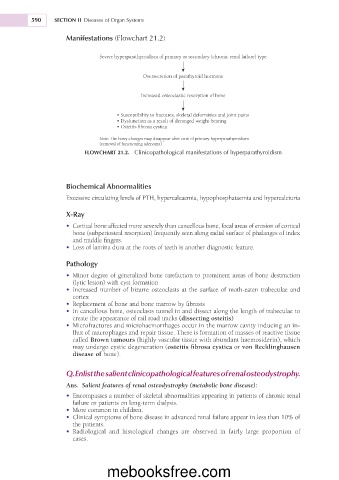
                     Manifestations (Flowchart 21.2)


                                Severe hyperparathyroidism of primary or secondary (chronic renal failure) type


                                             Oversecretion of parathyroid hormone


                                            Increased osteoclastic resorption of bone


                                     • Susceptibility to fractures, skeletal deformities and joint pains
                                     • Dysfunction as a result of deranged weight bearing
                                     • Osteitis fibrosa cystica
                                Note: The bony changes may disappear after cure of primary hyperparathyroidism
                                (removal of functioning adenoma).
                           FLOWCHART 21.2.  Clinicopathological manifestations of hyperparathyroidism


                     Biochemical Abnormalities
                     Excessive circulating levels of PTH, hypercalcaemia, hypophosphataemia and hypercalciuria

                     X-Ray

                     •	 Cortical bone affected more severely than cancellous bone, focal areas of erosion of cortical
                       bone (subperiosteal resorption) frequently seen along radial surface of phalanges of index
                       and middle fingers.
                     •	 Loss of lamina dura at the roots of teeth is another diagnostic feature.

                     Pathology
                     •	 Minor degree of generalized bone rarefaction to prominent areas of bone destruction
                       (lytic lesion) with cyst formation
                     •	 Increased  number  of  bizarre  osteoclasts  at  the  surface  of  moth-eaten  trabeculae  and
                       cortex
                     •	 Replacement of bone and bone marrow by fibrosis
                     •	 In cancellous bone, osteoclasts tunnel in and dissect along the length of trabeculae to
                       create the appearance of rail road tracks (dissecting	osteitis)
                     •	 Microfractures and microhaemorrhages occur in the marrow cavity inducing an in-
                       flux of macrophages and repair tissue. There is formation of masses of reactive tissue
                       called Brown	tumours (highly vascular tissue with abundant haemosiderin), which
                       may undergo cystic degeneration (osteitis	fibrosa	cystica or von	Recklinghausen
                       disease	of	bone).


                     Q. Enlist the salient clinicopathological features of renal osteodystrophy.
                     Ans.  Salient features of renal osteodystrophy (metabolic bone disease):
                     •	 Encompasses a number of skeletal abnormalities appearing in patients of chronic renal
                       failure or patients on long-term dialysis.
                     •	 More common in children.
                     •	 Clinical symptoms of bone disease in advanced renal failure appear in less than 10% of
                       the patients.
                     •	 Radiological  and  histological  changes  are  observed  in  fairly  large  proportion  of
                       cases.


                                  mebooksfree.com

