


Page 606 - Concise Pathology for Exam Preparation ( PDFDrive )
P. 606
21  Musculoskeletal System  591

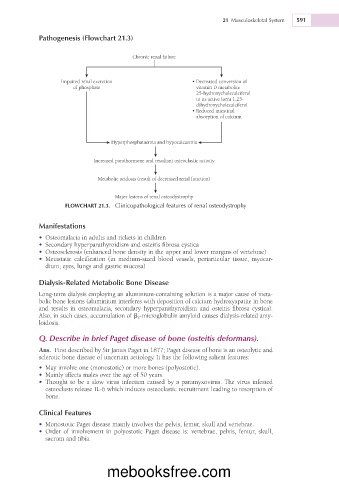
             Pathogenesis (Flowchart 21.3)


                                          Chronic renal failure


                    Impaired renal excretion                • Decreased conversion of
                        of phosphate                           vitamin D metabolite
                                                               25-hydroxycholecalciferol
                                                               to its active form 1,25-
                                                               dihydroxycholecalciferol
                                                            • Reduced intestinal
                                                               absorption of calcium


                                   Hyperphosphataemia and hypocalcaemia

                              Increased parathormone and resultant osteoclastic activity


                               Metabolic acidosis (result of decreased renal function)

                                    Major lesions of renal osteodystrophy
                     FLOWCHART 21.3.  Clinicopathological features of renal osteodystrophy


             Manifestations
             •	 Osteomalacia in adults and rickets in children
             •	 Secondary hyperparathyroidism and osteitis fibrosa cystica
             •	 Osteosclerosis (enhanced bone density in the upper and lower margins of vertebrae)
             •	 Metastatic  calcification  (in  medium-sized  blood  vessels,  periarticular  tissue,  myocar-
               dium, eyes, lungs and gastric mucosa)


             Dialysis-Related Metabolic Bone Disease
             Long-term dialysis employing an aluminium-containing solution is a major cause of meta-
             bolic bone lesions (aluminium interferes with deposition of calcium hydroxyapatite in bone
             and  results  in  osteomalacia,  secondary  hyperparathyroidism  and  osteitis  fibrosa  cystica).
             Also, in such cases, accumulation of b 2 -microglobulin amyloid causes dialysis-related amy-
             loidosis.

             Q. Describe in brief Paget disease of bone (osteitis deformans).

             Ans.  First described by Sir James Paget in 1877; Paget disease of bone is an osteolytic and
             sclerotic bone disease of uncertain aetiology. It has the following salient features:
             •	 May involve one (monostotic) or more bones (polyostotic).
             •	 Mainly affects males over the age of 50 years.
             •	 Thought to be a slow virus infection caused by a paramyxovirus. The virus infested
               osteoclasts release IL-6 which induces osteoclastic recruitment leading to resorption of
               bone.
             Clinical Features

             •	 Monostotic Paget disease mainly involves the pelvis, femur, skull and vertebrae.
             •	 Order  of  involvement  in  polyostotic  Paget  disease  is:  vertebrae,  pelvis,  femur,  skull,
               sacrum and tibia.


                                  mebooksfree.com

