


Page 608 - Concise Pathology for Exam Preparation ( PDFDrive )
P. 608
21  Musculoskeletal System  593


                                                                       Benign
                                                                       fibroblastic
                                                                       tissue


                                                                       Curvilinear bony
                                                                       trabeculae of
                                                                       woven bone


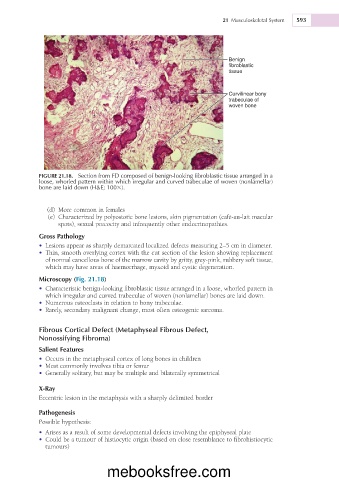
             FIGURE 21.18.  Section from FD composed of benign-looking fibroblastic tissue arranged in a
             loose, whorled pattern within which irregular and curved trabeculae of woven (nonlamellar)
             bone are laid down (H&E; 1003).


                  (d)  More common in females
                 (e)  Characterized by polyostotic bone lesions, skin pigmentation (café-au-lait macular
                   spots), sexual precocity and infrequently other endocrinopathies.

             Gross Pathology
             •	 Lesions appear as sharply demarcated localized defects measuring 2–5 cm in diameter.
             •	 Thin, smooth overlying cortex with the cut section of the lesion showing replacement
               of normal cancellous bone of the marrow cavity by gritty, grey-pink, rubbery soft tissue,
               which may have areas of haemorrhage, myxoid and cystic degeneration.
             Microscopy (Fig. 21.18)
             •	 Characteristic benign-looking fibroblastic tissue arranged in a loose, whorled pattern in
               which irregular and curved trabeculae of woven (nonlamellar) bones are laid down.
             •	 Numerous osteoclasts in relation to bony trabeculae.
             •	 Rarely, secondary malignant change, most often osteogenic sarcoma.

             Fibrous Cortical Defect (Metaphyseal Fibrous Defect,
             Nonossifying Fibroma)
             Salient Features
             •	 Occurs in the metaphyseal cortex of long bones in children
             •	 Most commonly involves tibia or femur
             •	 Generally solitary, but may be multiple and bilaterally symmetrical

             X-Ray
             Eccentric lesion in the metaphysis with a sharply delimited border
             Pathogenesis
             Possible hypothesis:
             •	 Arises as a result of some developmental defects involving the epiphyseal plate
             •	 Could be a tumour of histiocytic origin (based on close resemblance to fibrohistiocytic
               tumours)


                                  mebooksfree.com

