


Page 1117 - Hematology_ Basic Principles and Practice ( PDFDrive )
P. 1117
Chapter 62  Acute Myeloid Leukemia in Children  983


                                                           MLL-MLLT4
                                                              1%
                                             CBFβ-MYH11          MLL-MLLT10
                                                10%              1%
                                                                     MLL-ABI1
                                                                     1%
                                                                                MLL-MLLT3 8%


                RUNX1-RUNX1T1 15%


                                                                                                   DEK-NUP214
                                                                                                   1%
                                                                             Other MLL
                                                                               9%                  MYST3-CREBBP
                                                                                                   1%
                                                                                                   RUNX1-CBFA2T3
                                                                                                   1%
                                                                                                   CBFA2T3-GLIS2
                                                                                                   1%
                                                                                                   RBM15-MKL1
                                                                                                   1%
                                                                                 CEBPA
                                                                                  5%               −7
                                                                                                   1%
                   Other 9%

                                                                                              NPM1-mut/FLT3-ITD
                                        TET2                                                  3%
                                         5%
                                                                                           NPM1- mut/FLT3-wt
                                                                                           4%
                                                FLT3-TKD
                                                   5%
                                                                                 NPM1-wt/FLT3-ITD 8%
                                       IDH1/IDH2
                                             3%
                                                                      WT1 8%
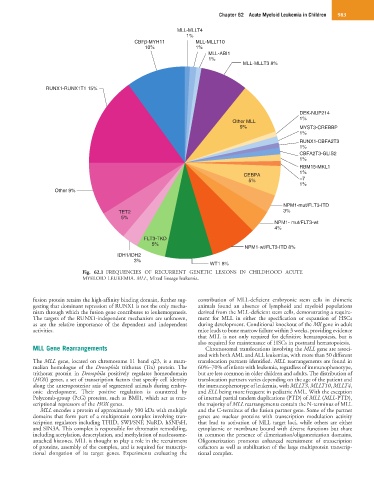
                            Fig.  62.1  FREQUENCIES  OF  RECURRENT  GENETIC  LESIONS  IN  CHILDHOOD  ACUTE
                            MYELOID LEUKEMIA. MLL, Mixed lineage leukemia.


            fusion protein retains the high-affinity binding domain, further sug-  contribution  of  MLL-deficient  embryonic  stem  cells  in  chimeric
            gesting that dominant repression of RUNX1 is not the only mecha-  animals  found  an  absence  of  lymphoid  and  myeloid  populations
            nism through which the fusion gene contributes to leukemogenesis.   derived from the MLL-deficient stem cells, demonstrating a require-
            The targets of the RUNX1-independent mechanism are unknown,   ment  for  MLL  in  either  the  specification  or  expansion  of  HSCs
            as  are  the  relative  importance  of  the  dependent  and  independent   during development. Conditional knockout of the Mll gene in adult
            activities.                                           mice leads to bone marrow failure within 3 weeks, providing evidence
                                                                  that MLL is not only required for definitive hematopoiesis, but is
                                                                  also required for maintenance of HSCs in postnatal hematopoiesis.
            MLL Gene Rearrangements                                 Chromosomal translocations involving the MLL gene are associ-
                                                                  ated with both AML and ALL leukemias, with more than 50 different
            The MLL gene, located on chromosome 11 band q23, is a mam-  translocation partners identified. MLL rearrangements are found in
            malian  homologue  of  the  Drosophila  trithorax  (Trx)  protein.  The   60%–70% of infants with leukemia, regardless of immunophenotype,
            trithorax  protein  in  Drosophila  positively  regulates  homeodomain   but are less common in older children and adults. The distribution of
            (HOX) genes, a set of transcription factors that specify cell identity   translocation partners varies depending on the age of the patient and
            along the anteroposterior axis of segmented animals during embry-  the immunophenotype of leukemia, with MLLT3, MLLT10, MLLT4,
            onic  development.  Their  positive  regulation  is  countered  by   and ELL being more frequent in pediatric AML. With the exception
            Polycomb-group (PcG) proteins, such as BMI1, which act as tran-  of internal partial tandem duplications (PTD) of MLL (MLL-PTD),
            scriptional repressors of the HOX genes.              the majority of MLL rearrangements contain the N-terminus of MLL
              MLL encodes a protein of approximately 500 kDa with multiple   and the C-terminus of the fusion partner gene. Some of the partner
            domains that form part of a multiprotein complex involving tran-  genes  are  nuclear  proteins  with  transcription  modulation  activity
            scription regulators including TFIID, SWI/SNF, NuRD, hSNFsH,   that  lead  to  activation  of  MLL  target  loci,  while  others  are  either
            and SIN3A. This complex is responsible for chromatin remodeling,   cytoplasmic  or  membrane  bound  with  diverse  functions  but  share
            including acetylation, deacetylation, and methylation of nucleosome-  in common the presence of dimerization/oligomerization domains.
            attached histones. MLL is thought to play a role in the recruitment   Oligomerization  promotes  enhanced  recruitment  of  transcription
            of proteins, assembly of the complex, and is required for transcrip-  cofactors as well as stabilization of the large multiprotein transcrip-
            tional  elongation  of  its  target  genes.  Experiments  evaluating  the   tional complex.

