


Page 1184 - Hematology_ Basic Principles and Practice ( PDFDrive )
P. 1184
1032   Part VII  Hematologic Malignancies


                                                                TABLE   Antigens Used for Immunophenotyping of Acute
                                                                66.2    Lymphoblastic Leukemia a
                                                                             Commonly Positive     Variable Expression
                                                               B-ALL         CD19 b                CD20
                                                                             cCD22 b               CD34
                                                                             cCD79a b              CD45
                                                                             Pax5 c                CD13 d
                                                                             CD10                  CD33 d
                                                                             sCD22                 sIgM e
                                                                             CD24                  CD58 d
                                                                             TdT                   CD38 d
                                                               T-ALL         TdT                   CD1a
                                                                             cCD3 f                CD2
                                                                             CD7                   sCD3
         A                         B                                                               CD4 g
                                                                                                   CD5
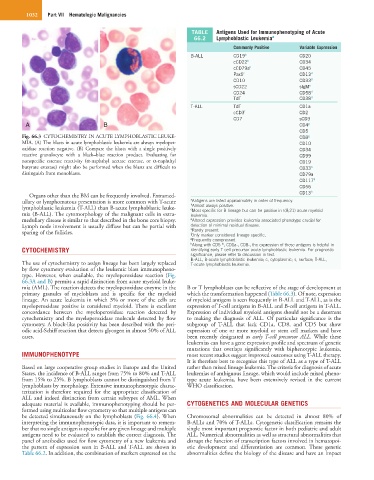
        Fig. 66.3  CYTOCHEMISTRY IN ACUTE LYMPHOBLASTIC LEUKE-                                     CD8 g
        MIA. (A) The blasts in acute lymphoblastic leukemia are always myeloper-                   CD10
        oxidase  reaction  negative.  (B)  Compare  the  blasts  with  a  single  positively       CD34
        reactive  granulocyte  with  a  black–blue  reaction  product.  Evaluating  for            CD99
        nonspecific  esterase  reactivity  (α-naphthyl  acetate  esterase,  or  α-naphthyl         CD19
        butyrate esterase) might also be performed when the blasts are difficult to                CD33 h
        distinguish from monoblasts.                                                               CD79a
                                                                                                   CD117 h
                                                                                                   CD56
                                                                                                   CD13 h
           Organs other than the BM can be frequently involved. Extramed-
        ullary or lymphomatous presentation is more common with T-acute   a b Antigens are listed approximately in order of frequency.
        lymphoblastic leukemia (T-ALL) than B-acute lymphoblastic leuke-  c Almost always positive.
                                                                Most specific for B lineage but can be positive in t(8;21) acute myeloid
        mia (B-ALL). The cytomorphology of the malignant cells in extra-  leukemia.
        medullary disease is similar to that described in the bone core biopsy.   d Altered expression provides leukemia associated phenotype crucial for
        Lymph node involvement is usually diffuse but can be partial with   detection of minimal residual disease.
                                                               e
                                                                Rarely present.
        sparing of the follicles.                              f Only marker considered lineage specific.
                                                               g Frequently coexpressed.
                                                               h Along with CD5  , CD1a-, CD8-, the expression of these antigens is helpful in
                                                                          lo
        CYTOCHEMISTRY                                          identifying early T-cell precursor acute lymphoblastic leukemia. For prognostic
                                                               significance, please refer to discussion in text.
                                                               B-ALL, B-acute lymphoblastic leukemia; c, cytoplasmic; s, surface; T-ALL,
        The use of cytochemistry to assign lineage has been largely replaced   T-acute lymphoblastic leukemia.
        by flow cytometry evaluation of the leukemic blast immunopheno-
        type.  However,  when  available,  the  myeloperoxidase  reaction  (Fig.
        66.3A and B) permits a rapid distinction from acute myeloid leuke-
        mia (AML). The reaction detects the myeloperoxidase enzyme in the   B or T lymphoblasts can be reflective of the stage of development at
        primary  granules  of  myeloblasts  and  is  specific  for  the  myeloid   which the transformation happened (Table 66.3). Of note, expression
        lineage.  An  acute  leukemia  in  which  3%  or  more  of  the  cells  are   of myeloid antigens is seen frequently in B-ALL and T-ALL, as is the
        myeloperoxidase  positive  is  considered  myeloid. There  is  excellent   expression of T-cell antigens in B-ALL and B-cell antigens in T-ALL.
        concordance  between  the  myeloperoxidase  reaction  detected  by   Expression of individual myeloid antigens should not be a deterrent
        cytochemistry  and  the  myeloperoxidase  molecule  detected  by  flow   to  making  the  diagnosis  of  ALL.  Of  particular  significance  is  the
        cytometry. A block-like positivity has been described with the peri-  subgroup  of  T-ALL  that  lack  CD1a,  CD8,  and  CD5  but  show
        odic acid-Schiff reaction that detects glycogen in almost 50% of ALL   expression of one or more myeloid or stem cell markers and have
        cases.                                                been  recently  designated  as  early T-cell  precursor  ALL. While  these
                                                              leukemias can have a gene expression profile and spectrum of genetic
                                                              mutations  that  overlaps  significantly  with  biphenotypic  leukemia,
        IMMUNOPHENOTYPE                                       most recent studies suggest improved outcomes using T-ALL therapy.
                                                              It is therefore best to recognize this type of ALL as a type of T-ALL
        Based on large cooperative group studies in Europe and the United   rather than mixed lineage leukemia. The criteria for diagnosis of acute
        States, the incidence of B-ALL ranges from 75% to 80% and T-ALL   leukemias of ambiguous lineage, which would include mixed pheno-
        from 15% to 25%. B lymphoblasts cannot be distinguished from T   type  acute  leukemia,  have  been  extensively  revised  in  the  current
        lymphoblasts by morphology. Extensive immunophenotypic charac-  WHO classification.
        terization  is  therefore  required  for  the  appropriate  classification  of
        ALL and indeed distinction from certain subtypes of AML. When
        adequate material is available, immunophenotyping should be per-  CYTOGENETICS AND MOLECULAR GENETICS
        formed using multicolor flow cytometry so that multiple antigens can
        be detected simultaneously on the lymphoblasts (Fig. 66.4). When   Chromosomal  abnormalities  can  be  detected  in  almost  80%  of
        interpreting the immunophenotypic data, it is important to remem-  B-ALLs and 70% of T-ALLs. Cytogenetic classification remains the
        ber that no single antigen is specific for any given lineage and multiple   single most important prognostic factor in both pediatric and adult
        antigens need to be evaluated to establish the correct diagnosis. The   ALL. Numerical abnormalities as well as structural abnormalities that
        panel of antibodies used for flow cytometry of a new leukemia and   disrupt the function of transcription factors involved in hematopoi-
        the pattern of expression seen in B-ALL and T-ALL are shown in   etic  development  and  differentiation  are  common.  These  genetic
        Table 66.2. In addition, the combination of markers expressed on the   abnormalities define the biology of the disease and have an impact

