


Page 1186 - Hematology_ Basic Principles and Practice ( PDFDrive )
P. 1186
1034   Part VII  Hematologic Malignancies


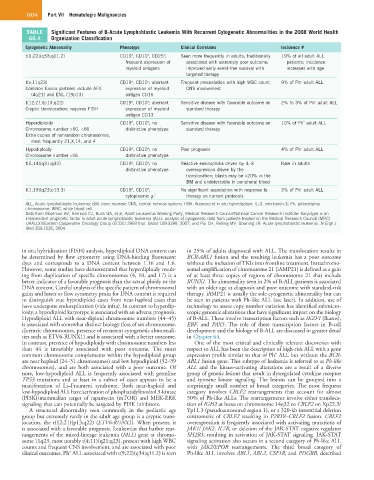
          TABLE   Significant Features of B-Acute Lymphoblastic Leukemia With Recurrent Cytogenetic Abnormalities in the 2008 World Health
          66.4    Organization Classification
         Cytogenetic Abnormality        Phenotype           Clinical Correlates              Incidence #
                                                 +
                                            +
                                                       +
         t(9;22)(q33;q11.2)             CD19 , CD10 , CD25 ;   Seen more frequently in adults; traditionally   19% of all adult ALL
                                          frequent expression of   associated with extremely poor outcome;   patients; incidence
                                          myeloid antigens    improved early event-free survival with   increases with age
                                                              targeted therapy
                                            +
                                                 −
         t(v;11q23)                     CD19 , CD10 ; aberrant   Frequent presentation with high WBC count,   9% of Ph  adult ALL
                                                                                                   –
         Common fusion partners include AF4   expression of myeloid   CNS involvement
           (4q21) and ENL (19p13)         antigen CD15
                                            +
                                                 +
         t(12;21)(p13;q22)              CD19 , CD10 ; aberrant   Sensitive disease with favorable outcome on   2% to 3% of Ph  adult ALL
                                                                                                        –
         Cryptic translocation; requires FISH  expression of myeloid   standard therapy
                                          antigen CD13
                                                                                                    –
         Hyperdiploidy                  CD19 , CD10 ; no    Sensitive disease with favorable outcome on   10% of Ph  adult ALL
                                            +
                                                 +
         Chromosome number >50, <66       distinctive phenotype  standard therapy
         Extra copies of nonrandom chromosomes,
           most frequently 21,X,14, and 4
                                            +
                                                                                                   –
         Hypodiploidy                   CD19 , CD10 ; no    Poor prognosis                   4% of Ph  adult ALL
                                                 +
         Chromosome number <46            distinctive phenotype
                                            +
                                                 +
         t(5;14)(q31;q32)               CD19 , CD10 ; no    Reactive eosinophilia driven by IL-3   Rare in adults
                                          distinctive phenotype  overexpression driven by the
                                                              translocation; blasts may be <20% in the
                                                              BM and undetectable in peripheral blood
                                                 +
         t(1;19)(q23;p13.3)             CD19 , CD10 ;       No significant association with response to   3% of Ph  adult ALL
                                            +
                                                                                                   –
                                          cytoplasmic µ +     therapy on current protocols
         ALL, Acute lymphoblastic leukemia; BM, bone marrow; CNS, central nervous system; FISH, fluorescent in situ hybridization; IL-3, interleukin-3; Ph, philadelphia
         chromosome; WBC, white blood cell.
         Data from Moorman AV, Harrison CJ, Buck GA, et al, Adult Leukaemia Working Party, Medical Research Council/National Cancer Research Institute: Karyotype is an
         independent prognostic factor in adult acute lymphoblastic leukemia (ALL): analysis of cytogenetic data from patients treated on the Medical Research Council (MRC)
         UKALLXII/Eastern Cooperative Oncology Group (ECOG) 2993 trial. Blood 109:3189, 2007; and Pui CH, Relling MV, Downing JR: Acute lymphoblastic leukemia. N Engl J
         Med 350:1535, 2004.
        in situ hybridization (FISH) analysis, hyperdiploid DNA content can   in 25% of adults diagnosed with ALL. The translocation results in
        be  determined  by  flow  cytometry  using  DNA-binding  fluorescent   BCR-ABL1 fusion and the resulting leukemia has a poor outcome
        dyes  and  corresponds  to  a  DNA  content  between  1.16  and  1.6.   without the inclusion of TKIs into frontline treatment. Intrachromo-
        However, some studies have demonstrated that hyperdiploidy result-  somal amplification of chromosome 21 (iAMP21) is defined as a gain
        ing from duplication of specific chromosomes (4, 10, and 17) is a   of at least three copies of regions of chromosome 21 that include
        better indicator of a favorable prognosis than the actual ploidy or the   RUNX1. The abnormality seen in 2% of B-ALL patients is associated
        DNA content. Careful analysis of the specific pattern of chromosomal   with an older age at diagnosis and poor outcome with standard-risk
        gains and losses or flow cytometry peaks for DNA content is required   therapy. iAMP21 is usually the sole cytogenetic abnormality but can
        to distinguish true hyperdiploid cases from near-haploid cases that   be seen in patients with Ph-like ALL (see later). In addition, use of
        have undergone endoreplication (vide infra). In contrast to hyperdip-  technology to assess copy number variation has identified submicro-
        loidy, a hypodiploid karyotype is associated with an adverse prognosis.   scopic genomic alterations that have significant impact on the biology
        Hypodiploid ALL with near-diploid chromosome numbers (44–45)   of B-ALL. These involve transcription factors such as IKZF1 (Ikaros),
        is associated with somewhat distinct biology (loss of sex chromosome,   EBF,  and  PAX5.  The  role  of  these  transcription  factors  in  B-cell
        dicentric chromosomes, presence of recurrent cytogenetic abnormali-  development and the biology of B-ALL are discussed in greater detail
        ties such as ETV6-RUNX1) and is associated with a better outcome.   in Chapter 64.
        In contrast, presence of hypodiploidy with chromosome numbers less   One of the most critical and clinically relevant discoveries with
        than  44  is  invariably  associated  with  poor  outcome.  The  most   respect to ALL has been the description of high-risk ALL with a gene
                                                                                           +
        common chromosome complements within the hypodiploid group   expression profile similar to that of Ph  ALL but without the BCR-
        are near haploid (24–31 chromosomes) and low hypodiploid (32–39   ABL1 fusion gene. This subtype of leukemia is referred to as Ph-like
        chromosomes),  and  are  both  associated  with  a  poor  outcome.  Of   ALL  and  the  kinase-activating  alterations  are  a  result  of  a  diverse
        note,  low-hypodiploid  ALL  is  frequently  associated  with  germline   group of genetic lesions that result in dysregulated cytokine receptor
        TP53  mutations  and  at  least  in  a  subset  of  cases  appears  to  be  a   and  tyrosine  kinase  signaling.  The  lesions  can  be  grouped  into  a
        manifestation  of  Li–Fraumeni  syndrome.  Both  near-haploid  and   surprisingly  small  number  of  broad  categories. The  most  frequent
        low-hypodiploid ALL have activation of phosphatidylinositol 3-kinase   category  involves  CRLF2  rearrangements  that  account  for  almost
        (PI3K)/mammalian  target  of  rapamycin  (mTOR)  and  MEK-ERK   50% of Ph-like ALLs. The rearrangements involve either transloca-
        signaling that can potentially be targeted by PI3K inhibitors.  tion of IGH2 at locus on chromosome 14q32 to CRLF2 on Xp22.3/
           A  structural  abnormality  seen  commonly  in  the  pediatric  age   Yp11.3 (pseudoautosomal region 1), or a 320-kb interstitial deletion
        group but extremely rarely in the adult age group is a cryptic trans-  centromeric  of  CRLF2  resulting  in  P2RY8–CRLF2  fusion.  CRLF2
        location, the t(12;21)(p13;q22) (ETV6-RUNX1). When present, it   overexpression is frequently associated with activating mutations of
        is associated with a favorable prognosis. Leukemias that harbor rear-  JAK1/ JAK2, IL7R, or deletion of the JAK-STAT negative regulator
        rangements of the mixed-lineage leukemia (MLL) gene at chromo-  SH2B3, resulting in activation of JAK-STAT signaling. JAK-STAT
        some 11q23, most notably t(4;11)(q21;q23), present with high WBC   signaling activation also occurs in a second category of Ph-like ALL
        counts and frequent CNS involvement, and are associated with poor   with  JAK2/EPOR  rearrangements.  The  third  broad  category  of
                        +
        clinical outcomes. Ph  ALL associated with t(9;22)(q34;q11.2) is seen   Ph-like ALL involves ABL1, ABL2, CSF1R, and PDGRB, described

