


Page 1185 - Hematology_ Basic Principles and Practice ( PDFDrive )
P. 1185
Chapter 66  Acute Lymphoblastic Leukemia in Adults  1033


                                                                        10 3
                                                                        10 2
                                                                        CD19 FITC  10 1 0

                                                                        10

                10 3                                   10 0  10 1  10 2  10 3  10 0  10 1  10 10 3  10 0  10 1  10 2  10 3
                                                                                         2
                                                         CD34 PC5                CD10 PE             CD20 FITC
                                                                         10 3
                10 2
                                                                         10 2
               SS log  10 1                                              LAMBDA PE  10 1 0


                10 0                                                     10
                                                                                         2
                                                       10 0  10 1  10 2  10 3  10 0  10 1  10 10 3  10 0  10 1  10 2  10 3
                                                         HLA-DR FITC             KAPPA FITC          cyCD79a PE
                                                                         10 3
                         10 0   10 1  10 2  10 3
                                                                         CD33 PE  10 1
                            CD45 ECD                                     10 2


                                                                         10 0
                                                                                         2
                                                       10 0  10 1  10 2  10 3  10 0  10 1  10 10 3  10 0  10 1  10 2  10 3
                                                         cyTDT FITC              CD19 PC5            cylgM PE
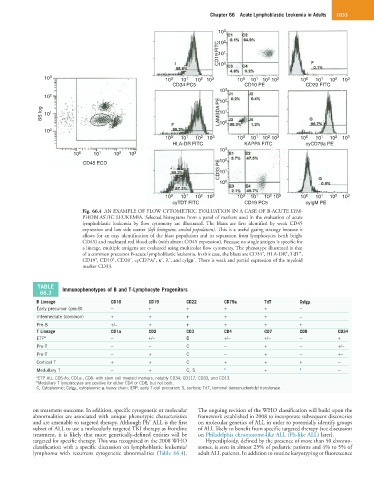
                            Fig. 66.4  AN EXAMPLE OF FLOW CYTOMETRIC EVALUATION IN A CASE OF B-ACUTE LYM-
                            PHOBLASTIC LEUKEMIA. Selected histograms from a panel of markers used in the evaluation of acute
                            lymphoblastic  leukemia  by  flow  cytometry  are  illustrated.  The  blasts  are  first  identified  by  weak  CD45
                            expression and low side scatter (left histogram, circled population). This is a useful gating strategy because it
                            allows for an easy identification of the blast population and its separation from lymphocytes (with bright
                            CD45) and nucleated red blood cells (with absent CD45 expression). Because no single antigen is specific for
                            a lineage, multiple antigens are evaluated using multicolor flow cytometry. The phenotype illustrated is that
                                                                                               +
                                                                                                   +
                                                                                       +
                            of a common precursor B-acute lymphoblastic leukemia. In this case, the blasts are CD34 , HLA-DR , TdT ,
                                                        −
                                            −
                                                   +
                                                                −
                                                      −
                                      +
                                +
                            CD19 , CD10 , CD20 , cyCD79a , κ , λ , and cyIgµ . There is weak and partial expression of the myeloid
                            marker CD33.
             TABLE   Immunophenotypes of B and T-Lymphocyte Progenitors
              66.3
             B Lineage               CD10         CD19        CD22        CD79a         TdT        CyIgµ
             Early precursor (pro-B)  −           +           +           +             +          −
             Intermediate (common)   +            +           +           +             +          −
             Pre-B                   +/−          +           +           +             +          +
             T Lineage               CD1a         CD2         CD3         CD4           CD7        CD8          CD34
             ETP a                   −            +/−         C           +/−           +/−        −            +
             Pro-T                   −            −           C           −             +          −            +/−
             Pre-T                   −            +           C           −             +          −            +−
             Cortical T              +            +           C           +             +          +            −
             Medullary T             −            +           C, S        b             +          b            −
             a ETP ALL CD5-/lo, CD1a-, CD8- with stem cell myeloid markers, notably CD34, CD117, CD33, and CD13.
             b Medullary T lymphocytes are positive for either CD4 or CD8, but not both.
             C, Cytoplasmic; CyIgµ, cytoplasmic µ heavy chain; ETP, early T-cell precursor; S, surface; TdT, terminal deoxynucleotidyl transferase.


            on treatment outcome. In addition, specific cytogenetic or molecular   The ongoing revision of the WHO classification will build upon the
            abnormalities are associated with unique phenotypic characteristics   framework established in 2008 to incorporate subsequent discoveries
                                                  +
            and are amenable to targeted therapy. Although Ph  ALL is the first   on molecular genetics of ALL in order to potentially identify groups
            subset of ALL to use a molecularly targeted TKI therapy as frontline   of ALL likely to benefit from specific targeted therapy (see discussion
            treatment, it is likely that more genetically-defined entities will be   on Philadelphia chromosome-like ALL (Ph-like ALL) later).
            targeted for specific therapy. This was recognized in the 2008 WHO   Hyperdiploidy, defined by the presence of more than 50 chromo-
            classification with a specific discussion on lymphoblastic leukemia/  somes, is seen in almost 25% of pediatric patients and 4% to 5% of
            lymphoma  with  recurrent  cytogenetic  abnormalities  (Table  66.4).   adult ALL patients. In addition to routine karyotyping or fluorescence

