


Page 1263 - Hematology_ Basic Principles and Practice ( PDFDrive )
P. 1263
Chapter 69  Essential Thrombocythemia  1109


            JAK2V617F-mediated  cell  regulation.  Thrombopoietin-mediated   The  incidence  of  thrombotic  events  in  ET  patients  ranges  from
            signaling regulates Lnk expression at both the mRNA and protein   1.5%  to  6.6%  per  patient-year. The  thrombotic  events  in  ET  are
            levels. Furthermore, acquired Lnk mutations have been observed in   largely arterial, but venous thromboses also occur not infrequently.
            less than 1% of ET. The inactivating Lnk mutations in ET patients   JAK2V617F-positive  ET  patients  compared  with  patients  with
            result in JAK-STAT activation, leading to high levels of STAT3 and   patients with a CALR mutation or those who are triple negative have
            STAT5 activation.                                     a higher risk of developing thrombotic events, but a dose-dependent
              Recently, Cabagnois and coworkers used whole-exome sequencing   correlation  between  allele  burden  and  the  development  of  clinical
            and next-generation sequencing targeting JAK2 and MPL with the   symptoms has not been demonstrated. The age-related differences in
            intent  of  detecting  additional  mutations  in  triple-negative  ET   the frequency of these events have been attributed to the coexistence
            patients.  They  found  several  signaling  mutations  including   of vascular disease in older patients. Many investigators have struggled
            JAK2V617F at very low allele frequency, as well as additional muta-  to  identify  ET  patients  who  are  at  the  greatest  risk  of  developing
            tions  such  as:  LNK  mutation,  MPL-S505N,  MPL-W515R,  and   thrombotic episodes. Recently, a new thrombotic scoring system has
                                                                                                                 1
            MPL-S204P. MPL-S204P and MPL-Y591N were shown to be weak   been  developed  by  investigators  on  both  sides  of  the  Atlantic.   In
            gain-of-function mutants increasing MPL signaling and conferring   the latest iteration of this risk stratification schema four categories
            either thrombopoietin hypersensitivity or independence to expressing   were delineated: very low risk (no thrombosis history, age ≤60 years,
            cells, but with a low efficiency. These data demonstrate that some   and  JAK2  unmutated);  low  risk  (no  thrombosis  history,  age  ≤60
            clonal, noncanonical MPL gain-of-function mutations are associated   years, and JAK2 mutated); intermediate risk (no thrombosis history,
            with  triple-negative  cases  of  ET.  In  the  triple-negative  patients  in   age  >60  years,  and  JAK2  unmutated)  and  high  risk  (thrombosis
            whom these mutations were not detected, a number had clonal while   history,  age  >60  years,  and  JAK2  mutation).  How  to  personalize
            the  others  had  polyclonal  hematopoiesis,  suggesting  that  certain   therapy based upon such a schema remains problematic and to date
            patients  with  triple-negative  ET  cannot  be  classified  as  having  an   untested. 2
            MPN and should be evaluated for inherited forms of thrombocytosis   Some progress has been made in defining the relationship between
            that will be discussed later.                         platelet  numbers  and  the  risks  for  thrombotic  and  hemorrhagic
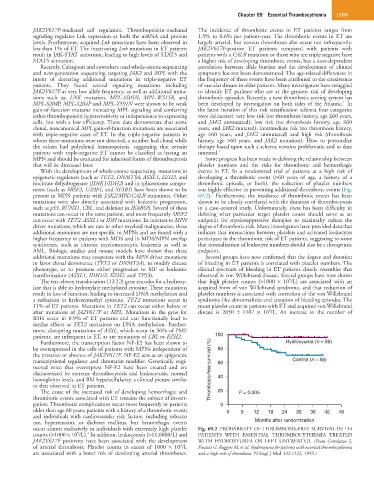
              With the development of whole-exome sequencing, mutations in   events  in  ET.  In  a  randomized  trial  of  patients  at  a  high  risk  of
            epigenetic regulators (such as TET2, DNMT3A, ASXL1, EZH2, and   developing  a  thrombotic  event  (>60  years  of  age,  a  history  of  a
            isocitrate dehydrogenase [IDH]1/IDH2) and in spliceosome compo-  thrombotic  episode,  or  both),  the  reduction  of  platelet  numbers
            nents (such as SRSF2, U2AF1, and SF3B1) have been shown to be   was highly effective in preventing additional thrombotic events (Fig.
                                                                      5
            present in MPN patients with JAK2/MPL/CALR mutations. Other   69.2).   Furthermore,  the  incidence  of  thrombotic  events  has  been
            mutations  were  also  directly  associated  with  leukemic  progression,   shown to be closely correlated with the duration of thrombocytosis
            such as p53, RUNX1, CBL, and deletion in IKAROS. Several of these   in a case–control study. Unfortunately, there has been difficulty in
            mutations can occur in the same patient, and most frequently SRSF2   defining  what  particular  target  platelet  count  should  serve  as  an
            can occur with TET2, ASXL1 or IDH mutations. In contrast to MPN   endpoint  for  myelosuppressive  therapies  to  maximally  reduce  the
            driver mutations, which are rare in other myeloid malignancies, these   degree of thrombotic risk. Many investigators have provided data that
            additional mutations are not specific to MPNs and are found with a   indicate that interactions between platelets and activated leukocytes
            higher frequency in patients with MDS and in MDS/MPN overlap   participate in the thrombotic risk of ET patients, suggesting to some
            syndromes,  such  as  chronic  myelomonocytic  leukemia  as  well  as   that normalization of leukocyte numbers should also be a therapeutic
            AML.  Biologic  studies  and  mouse  models  have  shown  that  these   endpoint.
            additional mutations may cooperate with the MPN driver mutations   Several groups have now confirmed that the degree and duration
            to favor clonal dominance (TET2 or DNMT3A), to modify disease   of bleeding in ET patients is correlated with platelet numbers. The
            phenotype,  or  to  promote  either  progression  to  MF  or  leukemic   clinical spectrum of bleeding in ET patients closely resembles that
            transformation (ASXL1, IDH1/2, EZH2, and TP53).       observed in von Willebrand disease. Several groups have now shown
                                                                                                9
              The ten–eleven translocation (TET2) gene encodes for a hydroxy-  that  high  platelet  counts  (>1000  ×  10 /L)  are  associated  with  an
            lase that is able to hydroxylate methylated cytosine. These mutations   acquired form of von Willebrand syndrome, and that reduction of
            result in loss of function, leading to increased DNA methylation and   platelet numbers is associated with correction of the von Willebrand
            a  reduction  in  hydroxymethyl  cytosine.  TET2  mutations  occur  in   syndrome-like abnormalities and cessation of bleeding episodes. The
            11% of ET patients. Mutations in TET2 can occur either before or   mean platelet count in patients with ET and acquired von Willebrand
                                                                                         9
            after  mutations  of  JA2V617F  or  MPL.  Mutations  in  the  gene  for   disease  is  2050  ±  1107  ×  10 /L.  An  increase  in  the  number  of
            IDH  occur  in  0.9%  of  ET  patients  and  can  functionally  lead  to
            similar  effects  as TET2  mutations  on  DNA methylation.  Further-
            more, disrupting mutations of ASXL, which occur in 36% of PMF
            patients, are infrequent in ET, as are mutations of CBL or EZH2.  100
              Furthermore, the transcription factor NF-E2 has been shown to                    Hydroxyurea (n = 56)
            be overexpressed in the cells of patients with MPNs independent of   80
            the presence or absence of JAK2V617F. NF-E2 acts as an epigenetic
            transcriptional regulator and chromatin modifier. Genetically engi-  60              Control (n = 58)
            neered  mice  that  overexpress  NF-E2  have  been  created  and  are   Thrombosis-free survival (%)
            characterized  by  extreme  thrombocytosis  and  leukocytosis,  normal   40
            hemoglobin levels, and BM hypercellularity, a clinical picture similar
            to that observed in ET patients.
              The cause of the increased risk of developing hemorrhagic and   20  P = 0.005
            thrombotic events associated with ET remains the subject of investi-
            gation. Thrombotic complications occur most frequently in patients   0
            older than age 60 years; patients with a history of a thrombotic event;   0  6  12  18  24  30  36  42  48
            and  individuals  with  cardiovascular  risk  factors,  including  tobacco
            use,  hypertension,  or  diabetes  mellitus,  but  hemorrhagic  events   Months after randomization
            occur almost exclusively in individuals with extremely high platelet   Fig. 69.2  PROBABILITY OF THROMBOSIS-FREE SURVIVAL IN 114
                          9
                              4
            counts (>1000 × 10 /L).  In addition, leukocytosis (>11,0000/L) and   PATIENTS  WITH  ESSENTIAL  THROMBOCYTHEMIA  TREATED
            JAK2V617F  positivity  have  been  associated  with  the  development   WITH  HYDROXYUREA  OR  LEFT  UNTREATED.  (From  Cortelazzo  S,
                                                            9
            of  arterial  thrombosis.  Platelet  counts  in  excess  of  1000  ×  10 /L   Finazzi G, Ruggeri M, et al: Hydroxyurea for patients with essential thrombocythemia
            are associated with a  lower  risk of  developing arterial  thromboses.   and a high risk of thrombosis. N Engl J Med 332:1132, 1995.)

