


Page 1266 - Hematology_ Basic Principles and Practice ( PDFDrive )
P. 1266
1112   Part VII  Hematologic Malignancies


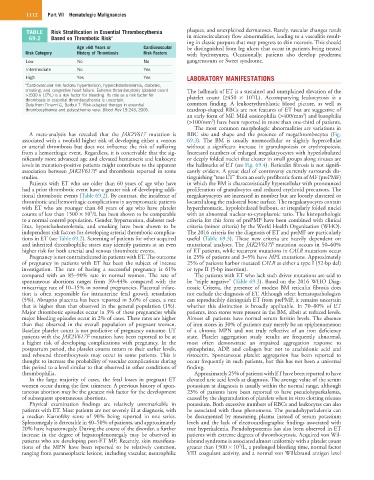
          TABLE   Risk Stratification in Essential Thrombocythemia   plaques, and unexplained dermatoses. Rarely, vascular changes result
          69.2    Based on Thrombotic Risk a                  in microcirculatory flow abnormalities, leading to a vasculitis result-
                                                              ing in classic purpura that may progress to skin necrosis. This should
                          Age >60 Years or      Cardiovascular   be distinguished from leg ulcers that occur in patients being treated
         Risk Category    History of Thrombosis  Risk Factors  with  hydroxyurea.  Occasionally,  patients  also  develop  pyoderma
         Low              No                    No            gangrenosum or Sweet syndrome.
         Intermediate     No                    Yes
         High             Yes                   Yes           LABORATORY MANIFESTATIONS
         a Cardiovascular risk factors: hypertension, hypercholesterolemia, diabetes,
         smoking, and congestive heart failure. Extreme thrombocytosis (platelet count   The hallmark of ET is a sustained and unexplained elevation of the
         >1500 × 10 /L) is a risk factor for bleeding. Its role as a risk factor for   platelet  count  (≥450  ×  10 /L).  Accompanying  leukocytosis  is  a
                 9
                                                                                   9
         thrombosis in essential thrombocythemia is uncertain.
         Data from Finazzi G, Barbui T: Risk-adapted therapy in essential   common  finding.  A  leukoerythroblastic  blood  picture,  as  well  as
         thrombocythemia and polycythemia vera. Blood Rev 19:243, 2005.  teardrop-shaped RBCs are not features of ET but are suggestive of
                                                                                                    3
                                                              an early form of MF. Mild eosinophilia (>400/mm ) and basophilia
                                                                      3
                                                              (>100/mm ) have been reported in more than one-third of patients.
                                                                 The most common morphologic abnormalities are variations in
           A  meta-analysis  has  revealed  that  the  JAK2V617  mutation  is   RBC  size  and  shape  and  the  presence  of  megathrombocytes  (Fig.
        associated with a twofold higher risk of developing either a venous   69.3).  The  BM  is  usually  normocellular  or  slightly  hypercellular
        or  arterial  thrombosis  but  does  not  influence  the  risk  of  suffering   without  a  significant  increase  in  granulopoiesis  or  erythropoiesis.
        from a hemorrhagic event. Regardless, it is conceivable that the sig-  Increased numbers of enlarged megakaryocytes with hyperlobulated
        nificantly more advanced age and elevated hematocrit and leukocyte   or deeply folded nuclei that cluster in small groups along sinuses are
        levels in mutation-positive patients might contribute to the apparent   the hallmarks of ET (see Fig. 69.4). Reticulin fibrosis is not signifi-
        association between JAK2V617F and thrombosis reported in some   cantly evident. A great deal of controversy currently surrounds dis-
        studies.                                              tinguishing “true ET” from an early prefibrotic form of MF (prePMF)
           Patients with ET who are older than 60 years of age who have   in which the BM is characteristically hypercellular with pronounced
        had a prior thrombotic event have a greater risk of developing addi-  proliferation of granulocytes and reduced erythroid precursors. The
        tional thrombotic events (Table 69.2). By contrast, the incidence of   megakaryocytes are increased in number but are loosely clustered or
        thrombotic and hemorrhagic complications in asymptomatic patients   located along the endosteal bone surface. The megakaryocytes contain
        with ET who are younger than 60 years of age who have platelet   hyperchromatic, hypolobulated bulbous, or irregularly folded nuclei
                               9
        counts of less than 1500 × 10 /L has been shown to be comparable   with an abnormal nuclear-to-cytoplasmic ratio. The histopathologic
        to a normal control population. Gender, hypertension, diabetes mel-  criteria for this form of prePMF have been combined with clinical
        litus,  hypercholesterolemia,  and  smoking  have  been  shown  to  be   criteria (minor criteria) by the World Health Organization (WHO).
        independent risk factors for developing arterial thrombotic complica-  The 2016 criteria for the diagnosis of ET and preMF are particularly
        tions in ET (see Table 69.2). Screening of patients for other acquired   useful  (Table  69.3).  These  new  criteria  are  heavily  dependent  on
        and inherited thrombophilic states may identify patients at an even   mutational analyses. The JAK2V617F mutation occurs in 50–60%
        higher risk for both arterial and venous thrombotic events.  of ET patients, while recurrent mutations in CALR mutations occur
           Pregnancy is not contraindicated in patients with ET. The outcome   in 25% of patients and 3–5% have MPL mutations. Approximately
        of  pregnancy  in  patients  with  ET  has  been  the  subject  of  intense   25% of patients harbor mutated CALR as either a type I (52-bp del)
        investigation.  The  rate  of  having  a  successful  pregnancy  is  61%   or type II (5-bp insertion).
        compared  with  an  85–90%  rate  in  normal  women.  The  rate  of   The patients with ET who lack such driver mutations are said to
        spontaneous  abortions  ranges  from  39–44%  compared  with  the   be “triple negative” (Table 69.3). Based on the 2016 WHO Diag-
        miscarriage rate of 10–15% in normal pregnancies. Placental infarc-  nostic  Criteria,  the  presence  of  modest  BM  reticulin  fibrosis  does
        tion  is  often  responsible  for  intrauterine  fetal  growth  retardation   not exclude the diagnosis of ET. Although select hematopathologists
        (5%). Abruptio placenta has been reported in 3.6% of cases, a rate   can reproducibly distinguish ET from prePMF, it remains uncertain
        that  is  higher  than  that  observed  in  the  general  population  (1%).   whether  this  distinction  is  broadly  applicable.  In  70–80%  of  ET
        Major thrombotic episodes occur in 3% of these pregnancies while   patients, iron stores were present in the BM, albeit at reduced levels.
        major bleeding episodes occur in 2% of cases. These rates are higher   Almost all patients have normal serum ferritin levels. The absence
        than  that  observed  in  the  overall  population  of  pregnant  women.   of iron stores in 30% of patients may merely be an epiphenomenon
        Baseline platelet count is not predictive of pregnancy outcome. ET   of  a  chronic  MPN  and  not  truly  reflective  of  an  iron  deficiency
        patients with the JAK2V617F mutation have been reported to be at   state.  Platelet  aggregation  study  results  are  frequently  abnormal,
        a  higher  risk  of  developing  complications  with  pregnancy.  In  the   most  often  demonstrate  an  impaired  aggregation  response  to
        postpartum period, the platelet counts return to their earlier levels,   epinephrine,  ADP,  and  collagen  but  not  to  arachidonic  acid  and
        and  rebound  thrombocytosis  may  occur  in  some  patients. This  is   ristocetin.  Spontaneous  platelet  aggregation  has  been  reported  to
        thought to increase the probability of vascular complications during   occur frequently in such patients, but this has not been a universal
        this period to a level similar to that observed in other conditions of   finding.
        thrombophilia.                                           Approximately 25% of patients with ET have been reported to have
           In  the  large  majority  of  cases,  the  fetal  losses  in  pregnant  ET   elevated uric acid levels at diagnosis. The average value of the serum
        women occur during the first trimester. A previous history of spon-  potassium at diagnosis is usually within the normal range, although
        taneous abortion may be the greatest risk factor for the development   23%  of  patients  have  been  reported  to  have  pseudohyperkalemia,
        of subsequent spontaneous abortions.                  caused by the degranulation of platelets when in vitro clotting releases
           Physical  examination  findings  are  relatively  unremarkable  in   potassium. Both excessive numbers of RBCs and leukocytes can also
        patients with ET. Most patients are not severely ill at diagnosis, with   be associated with these phenomena. The pseudohyperkalemia can
        a  median  Karnofsky  score  of  90%  being  reported  in  one  series.   be  documented  by  measuring  plasma  instead  of  serum  potassium
        Splenomegaly is detectable in 40–50% of patients, and approximately   levels and the lack of electrocardiographic findings associated with
        20% have hepatomegaly. During the course of the disorder, a further   true hyperkalemia. Pseudohypoxemia has also been observed in ET
        increase  in  the  degree  of  hepatosplenomegaly  may  be  observed  in   patients with extreme degrees of thrombocytosis. Acquired von Wil-
        patients who are developing post-ET MF. Recently, skin manifesta-  lebrand syndrome is associated almost uniformly with a platelet count
                                                                               9
        tions  of  the  MPN  have  been  reported  to  be  relatively  common,   greater than 1500 × 10 /L, a prolonged bleeding time, normal factor
        ranging from paraneoplastic lesions, including vascular, neutrophilic   VIII coagulant activity, and a normal von Willebrand antigen level

