


Page 1268 - Hematology_ Basic Principles and Practice ( PDFDrive )
P. 1268
1114   Part VII  Hematologic Malignancies


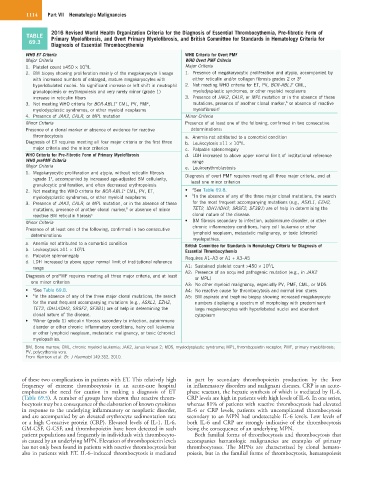
                  2016 Revised World Health Organization Criteria for the Diagnosis of Essential Thrombocythemia, Pre-fibrotic Form of
          TABLE   Primary Myelofibrosis, and Overt Primary Myelofibrosis, and British Committee for Standards in Hematology Criteria for
          69.3    Diagnosis of Essential Thrombocythemia

         WHO ET Criteria                                      WHO Criteria for Overt PMF
         Major Criteria                                       WHO Overt PMF Criteria
                             9
         1.  Platelet count ≥450 × 10 /L                      Major Criteria
         2.  BM biopsy showing proliferation mainly of the megakaryocyte lineage   1.  Presence of megakaryocytic proliferation and atypia, accompanied by
            with increased numbers of enlarged, mature megakaryocytes with   either reticulin and/or collagen fibrosis grades 2 or 3 a
                                                                                                 +
            hyperlobulated nuclei. No significant increase or left shift in neutrophil   2.  Not meeting WHO criteria for ET, PV, BCR-ABL1  CML,
            granulopoiesis or erythropoiesis and very rarely minor (grade 1)   myelodysplastic syndromes, or other myeloid neoplasms
            increase in reticulin fibers                      3.  Presence of JAK2, CALR, or MPL mutation or in the absence of these
                                                                                               b
         3.  Not meeting WHO criteria for BCR-ABL1  CML, PV, PMF,   mutations, presence of another clonal marker,  or absence of reactive
                                       +
            myelodysplastic syndromes, or other myeloid neoplasms  myelofibrosis c
         4.  Presence of JAK2, CALR, or MPL mutation          Minor Criteria
         Minor Criteria                                       Presence of at least one of the following, confirmed in two consecutive
         Presence of a clonal marker or absence of evidence for reactive   determinations:
            thrombocytosis                                     a.  Anemia not attributed to a comorbid condition
         Diagnosis of ET requires meeting all four major criteria or the first three    b.  Leukocytosis ≥11 × 10 /L
                                                                               9
            major criteria and the minor criterion             c.  Palpable splenomegaly
         WHO Criteria for Pre-Fibrotic Form of Primary Myelofibrosis   d.  LDH increased to above upper normal limit of institutional reference
         WHO prePMF Criteria                                    range
         Major Criteria                                        e.  Leukoerythroblastosis
         1.  Megakaryocytic proliferation and atypia, without reticulin fibrosis   Diagnosis of overt PMF requires meeting all three major criteria, and at
            >grade 1 , accompanied by increased age-adjusted BM cellularity,   least one minor criterion
                  a
            granulocytic proliferation, and often decreased erythropoiesis
         2.  Not meeting the WHO criteria for BCR-ABL1  CML, PV, ET,   •   a See Table 69.8.
                                          +
            myelodysplastic syndromes, or other myeloid neoplasms  •   b In the absence of any of the three major clonal mutations, the search
         3.  Presence of JAK2, CALR, or MPL mutation, or in the absence of these   for the most frequent accompanying mutations (e.g., ASXL1, EZH2,
                                          b
            mutations, presence of another clonal marker,  or absence of minor   TET2, IDH1/IDH2, SRSF2, SF3B1) are of help in determining the
            reactive BM reticulin fibrosis c                    clonal nature of the disease.
         Minor Criteria                                       •  BM fibrosis secondary to infection, autoimmune disorder, or other
         Presence of at least one of the following, confirmed in two consecutive   chronic inflammatory conditions, hairy cell leukemia or other
           determinations:                                      lymphoid neoplasm, metastatic malignancy, or toxic (chronic)
                                                                myelopathies.
          a.  Anemia not attributed to a comorbid condition   British Committee for Standards in Hematology Criteria for Diagnosis of
          b.  Leukocytosis ≥11 × 10 /L                        Essential Thrombocythemia
                           9
          c.  Palpable splenomegaly                           Requires A1–A3 or A1 + A3–A5
          d.  LDH increased to above upper normal limit of institutional reference       9
            range                                             A1:  Sustained platelet count >450 × 10 /L
         Diagnosis of prePMF requires meeting all three major criteria, and at least   A2:  Presence of an acquired pathogenic mutation (e.g., in JAK2
                                                                 or MPL)
           one minor criterion                                A3:  No other myeloid malignancy, especially PV, PMF, CML, or MDS
         •   a See Table 69.8.                                A4:  No reactive cause for thrombocytosis and normal iron stores
         •   b In the absence of any of the three major clonal mutations, the search   A5:  BM aspirate and trephine biopsy showing increased megakaryocyte
            for the most frequent accompanying mutations (e.g., ASXL1, EZH2,   numbers displaying a spectrum of morphology with predominant
            TET2, IDH1/IDH2, SRSF2, SF3B1) are of help in determining the   large megakaryocytes with hyperlobated nuclei and abundant
            clonal nature of the disease.                        cytoplasm
         •   c Minor (grade 1) reticulin fibrosis secondary to infection, autoimmune
            disorder or other chronic inflammatory conditions, hairy cell leukemia
            or other lymphoid neoplasm, metastatic malignancy, or toxic (chronic)
            myelopathies.
         BM, Bone marrow; CML, chronic myeloid leukemia; JAK2, Janus kinase 2; MDS, myelodysplastic syndrome; MPL, thrombopoietin receptor; PMF, primary myelofibrosis;
         PV, polycythemia vera.
         From Harrison et al: Br. J Haemotol 149:352, 2010.


        of these two complications in patients with ET. This relatively high   in  part  by  secondary  thrombopoietin  production  by  the  liver
        frequency  of  extreme  thrombocytosis  in  an  acute-care  hospital   in inflammatory disorders and malignant diseases. CRP is an acute-
        emphasizes  the  need  for  caution  in  making  a  diagnosis  of  ET     phase reactant, the hepatic synthesis of which is mediated by IL-6.
        (Table 69.5). A number of groups have shown that reactive throm-  CRP levels are high in patients with high levels of IL-6. In one series,
        bocytosis may be a consequence of the elaboration of known cytokines   whereas 81% of patients with reactive thrombocytosis had elevated
        in response to the underlying inflammatory or neoplastic disorder,   IL-6  or  CRP  levels,  patients  with  uncomplicated  thrombocytosis
        and are accompanied by an elevated erythrocyte sedimentation rate   secondary to an MPN had undetectable IL-6 levels. Low levels of
        or  a  high  C-reactive  protein  (CRP).  Elevated  levels  of  IL-1,  IL-6,   both  IL-6  and  CRP  are  strongly  indicative  of  the  thrombocytosis
        GM-CSF, G-CSF, and thrombopoietin have been detected in such   being the consequence of an underlying MPN.
        patient populations and frequently in individuals with thrombocyto-  Both familial forms of thrombocytosis and thrombocytosis that
        sis caused by an underlying MPN. Elevation of thrombopoietin levels   accompanies  hematologic  malignancies  are  examples  of  primary
        has not only been found in patients with reactive thrombocytosis but   thrombocytoses.  The  MPNs  are  characterized  by  clonal  hemato-
        also in patients with ET. IL-6–induced thrombocytosis is mediated   poiesis, but in the familial forms of thrombocytosis, hematopoiesis

