


Page 1267 - Hematology_ Basic Principles and Practice ( PDFDrive )
P. 1267
Chapter 69  Essential Thrombocythemia  1113


                       A                          B                                  C

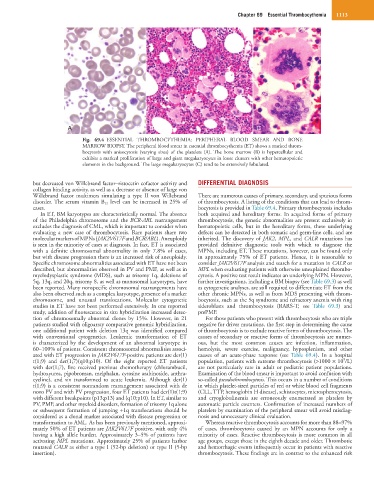
                            Fig.  69.4  ESSENTIAL  THROMBOCYTHEMIA:  PERIPHERAL  BLOOD  SMEAR  AND  BONE
                            MARROW BIOPSY. The peripheral blood smear in essential thrombocythemia (ET) shows a marked throm-
                            bocytosis  with  anisocytosis  (varying  sizes)  of  the  platelets  (A). The  bone  marrow  (B)  is  hypercellular  and
                            exhibits a marked proliferation of large and giant megakaryocytes in loose clusters with other hematopoietic
                            elements in the background. The large megakaryocytes (C) tend to be extensively lobulated.


            but decreased von Willebrand factor–ristocetin cofactor activity and   DIFFERENTIAL DIAGNOSIS
            collagen binding activity, as well as a decrease or absence of large von
            Willebrand  factor  multimers  simulating  a  type  II  von  Willebrand   There are numerous causes of primary, secondary, and spurious forms
            disorder. The serum vitamin B 12  level can be increased in 25% of   of thrombocytosis. A listing of the conditions that can lead to throm-
            cases.                                                bocytosis is provided in Table 69.4. Primary thrombocytosis includes
              In ET, BM karyotypes are characteristically normal. The absence   both acquired and hereditary forms. In acquired forms of primary
            of the Philadelphia chromosome and the BCR-ABL rearrangement   thrombocytosis, the genetic abnormalities are present exclusively in
            excludes the diagnosis of CML, which is important to consider when   hematopoietic  cells,  but  in  the  hereditary  forms,  these  underlying
            evaluating  a  new  case  of  thrombocytosis.  Rare  patients  share  two   defects can be detected in both somatic and germ-line cells, and are
            molecular markers of MPNs (JAK2V617F and BCR/ABL). Aneuploidy   inherited. The discovery of JAK2, MPL, and CALR mutations has
            is seen in the minority of cases at diagnosis. In fact, ET is associated   provided  definitive  diagnostic  tools  with  which  to  diagnose  the
            with  a  definite  chromosomal  abnormality  in  only  7.8%  of  cases,   MPNs, including ET. These mutations, however, can be found only
            but with disease progression there is an increased risk of aneuploidy.   in  approximately  75%  of  ET  patients.  Hence,  it  is  reasonable  to
            Specific chromosome abnormalities associated with ET have not been   consider JAK2V617F analysis and search for a mutation in CALR or
            described, but abnormalities observed in PV and PMF, as well as in   MPL when evaluating patients with otherwise unexplained thrombo-
            myelodysplastic syndrome (MDS), such as trisomy 1q, deletions of   cytosis. A positive test result indicates an underlying MPN. However,
            5q, 13q, and 20q, trisomy 8, as well as monosomal karyotypes, have   further investigations, including a BM biopsy (see Table 69.3) as well
            been reported. Many nonspecific chromosomal rearrangements have   as cytogenetic analyses, are still required to differentiate ET from the
            also been observed such as a complex karyotype, presence of a marker   other chronic MPNs, as well as from MDS presenting with throm-
            chromosome,  and  unusual  translocations.  Molecular  cytogenetic   bocytosis, such as the 5q syndrome and refractory anemia with ring
            studies in ET have not been performed extensively. In one reported   sideroblasts  and  thrombocytosis  (RARS-T;  see  Table  69.3)  and
            study, addition of fluorescence in situ hybridization increased detec-  prePMF.
            tion  of  chromosomally  abnormal  clones  by  15%.  However,  in  21   For those patients who present with thrombocytosis who are triple
            patients studied with oligoarray comparative genomic hybridization,   negative for driver mutations, the first step in determining the cause
            one  additional  patient  with  deletion  13q  was  identified  compared   of thrombocytosis is to exclude reactive forms of thrombocytosis. The
            with  conventional  cytogenetics.  Leukemic  transformation  of  ET   causes of secondary or reactive forms of thrombocytosis are numer-
            is  characterized  by  the  development  of  an  abnormal  karyotype  in   ous,  but  the  most  common  causes  are  infection,  inflammation,
            60–100% of patients. Consistent chromosomal abnormalities associ-  hemolysis,  severe  exercise,  malignancy,  hyposplenism,  and  other
            ated with ET progression in JAK2V617F-positive patients are der(1)  causes  of  an  acute-phase  response  (see  Table  69.4).  In  a  hospital
                                                                                                                 9
            t(1;9)  and  der(1;7)(q10;p10).  Of  the  eight  reported  ET  patients   population, patients with extreme thrombocytosis (>1000 × 10 /L)
            with  der(1;7),  five  received  previous  chemotherapy  (chlorambucil,   are  not  particularly  rare  in  adult  or  pediatric  patient  populations.
            hydroxyurea, pipobroman, melphalan, cytosine arabinoside, anthra-  Examination of the blood smear is important to avoid confusion with
            cycline),  and  six  transformed  to  acute  leukemia.  Although  der(1)  so-called pseudothrombocytosis. This occurs in a number of conditions
            t(1;9) is a consistent nonrandom rearrangement associated with de   in which platelet-sized particles of red or white blood cell fragments
            novo PV and with PV progression, four ET patients had der(1)t(1;9)   (CLL, TTP, hemoglobin H disease), schistocytes, microspherocytosis,
            with different breakpoints (p13;p13) and (q10;p10). In ET, similar to   and  cryoglobulinemia  are  erroneously  enumerated  as  platelets  by
            PV, PMF, and other myeloid disorders, formation of trisomy 1q alone   automatic particle counters. Confirmation of increased numbers of
            or subsequent formation of jumping +1q translocations should be   platelets by examination of the peripheral smear will avoid misdiag-
            considered as a clonal marker associated with disease progression or   nosis and unnecessary clinical evaluation.
            transformation to AML. As has been previously mentioned, approxi-  Whereas reactive thrombocytosis accounts for more than 88–97%
            mately 50% of ET patients are JAK2V617F positive, with only 4%   of  cases,  thrombocytosis  caused  by  an  MPN  accounts  for  only  a
            having a high allele burden. Approximately 3–5% of patients have   minority of cases. Reactive thrombocytosis is more common in all
            activating MPL mutations. Approximately 25% of patients harbor   age groups, except those in the eighth decade and older. Thrombotic
            mutated CALR as either a type I (52-bp deletion) or type II (5-bp   and hemorrhagic events infrequently occur in patients with reactive
            insertion).                                           thrombocytosis. These findings are in contrast to the enhanced risk

