


Page 1269 - Hematology_ Basic Principles and Practice ( PDFDrive )
P. 1269
Chapter 69  Essential Thrombocythemia  1115


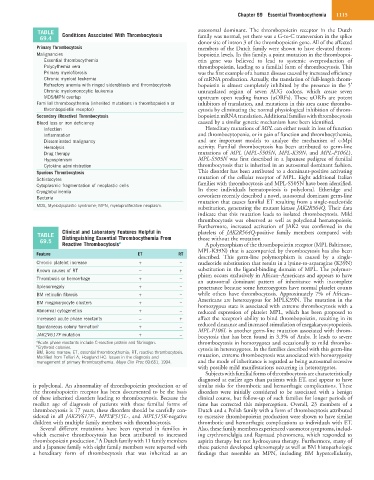
             TABLE   Conditions Associated With Thrombocytosis    autosomal  dominant.  The  thrombopoietin  receptor  in  the  Dutch
              69.4                                                family was normal, yet there was a G-to-C transversion in the splice
                                                                  donor site of intron 3 of the thrombopoietin gene. All of the affected
             Primary Thrombocytosis                               members of the Dutch family were shown to have elevated throm-
             Malignancies                                         bopoietin levels. In this family, a point mutation in the thrombopoi-
               Essential thrombocythemia                          etin  gene  was  believed  to  lead  to  systemic  overproduction  of
               Polycythemia vera                                  thrombopoietin, leading to a familial form of thrombocytosis. This
               Primary myelofibrosis                              was the first example of a human disease caused by increased efficiency
               Chronic myeloid leukemia                           of mRNA production. Actually, the translation of full-length throm-
               Refractory anemia with ringed sideroblasts and thrombocytosis  bopoietin is almost completely inhibited by the presence in the 5′
               Chronic myelomonocytic leukemia                    untranslated  region  of  seven  AUG  codons,  which  create  seven
               MDS/MPN overlap                                    upstream  open  reading  frames  (uORFs). These  uORFs  are  potent
             Familial thrombocythemia (inherited mutations in thrombopoietin or   inhibitors of translation, and mutations in this area cause thrombo-
               thrombopoietin receptor)                           cytosis by eliminating the normal physiological inhibition of throm-
             Secondary (Reactive) Thrombocytosis                  bopoietin mRNA translation. Additional families with thrombocytosis
             Blood loss or iron deficiency                        caused by a similar genetic mechanism have been identified.
               Infection                                            Hereditary mutations of MPL can either result in loss of function
               Inflammation                                       and thrombocytopenia, or in gain of function and thrombocythemia,
               Disseminated malignancy                            and  are  important  models  to  analyze  the  mechanism  of  c-Mpl
               Hemolysis                                          activity.  Familial  thrombocytosis  has  been  attributed  to  germ-line
               Drug therapy                                       mutations  of  MPL  (MPL-S505N,  MPL-K39N,  and  MPL-P106L).
               Hyposplenism                                       MPL-S505N  was  first  described  in  a  Japanese  pedigree  of  familial
               Cytokine administration                            thrombocytosis that is inherited in an autosomal dominant fashion.
             Spurious Thrombocytosis                              This disorder has been attributed to a dominant-positive activating
             Schistocytes                                         mutation of the cellular receptor of MPL. Eight additional Italian
             Cytoplasmic fragmentation of neoplastic cells        families with thrombocytosis and MPL-S505N have been identified.
             Cryoglobulinemia                                     In  these  individuals  hematopoiesis  is  polyclonal.  Etheridge  and
             Bacteria                                             coworkers recently described a novel, autosomal dominant germ-line
                                                                  mutation that causes familial ET resulting from a single-nucleotide
             MDS, Myelodysplastic syndrome; MPN, myeloproliferative neoplasm.  substitution, generating the mutant kinase JAK2R564Q. Their data
                                                                  indicate  that  this  mutation  leads  to  isolated  thrombocytosis.  Mild
                                                                  thrombocytosis  was  observed  as  well  as  polyclonal  hematopoiesis.
                                                                  Furthermore,  increased  activation  of  JAK2  was  confirmed  in  the
                     Clinical and Laboratory Features Helpful in   platelets  of  JAK2R564Q-positive  family  members  compared  with
             TABLE   Distinguishing Essential Thrombocythemia From
              69.5   Reactive Thrombocytosis a                    those without the mutation
                                                                    A polymorphism of the thrombopoietin receptor (MPL Baltimore,
                                                                  MPL-K39N) that is accompanied by thrombocytosis has also been
             Feature                          ET           RT
                                                                  described.  This  germ-line  polymorphism  is  caused  by  a  single-
             Chronic platelet increase        +             −     nucleotide substitution that results in a lysine-to-asparagine (K39N)
             Known causes of RT               −             +     substitution in the ligand-binding domain of MPL. The polymor-
             Thrombosis or hemorrhage         +             −     phism occurs exclusively in African–Americans and appears to have
                                                                  an  autosomal  dominant  pattern  of  inheritance  with  incomplete
             Splenomegaly                     +             −     penetrance because some heterozygotes have normal platelet counts
             BM reticulin fibrosis            +             −     while  others  have  thrombocytosis.  Approximately  7%  of  African–
                                                                  Americans  are  heterozygous  for  MPLK39N. The  mutation  in  the
             BM megakaryocyte clusters        +             −
                                                                  homozygous state is associated with extreme thrombocytosis with a
             Abnormal cytogenetics            +             −     reduced  expression  of  platelet  MPL,  which  has  been  proposed  to
             Increased acute phase reactants   −            +     affect the receptor’s ability to bind thrombopoietin, resulting in its
             Spontaneous colony formation b   +             −     reduced clearance and increased stimulation of megakaryocytopoiesis.
                                                                  MPL-P106L is another germ-line mutation associated with throm-
             JAK2V617F mutation               +             −     bocytosis that has been found in 3.3% of Arabs. It leads to severe
             a Acute phase reactants include C-reactive protein and fibrinogen.  thrombocytosis in homozygotes and occasionally to mild thrombo-
             b Erythroid colonies.                                cytosis in heterozygotes. In the families described with this germ-line
             BM, Bone marrow; ET, essential thrombocythemia; RT, reactive thrombocytosis.  mutation, extreme thrombocytosis was associated with homozygosity
             Modified from Tefferi A, Hoagland HC: Issues in the diagnosis and
             management of primary thrombocythemia. Mayo Clin Proc 69:651, 1994.  and the mode of inheritance is regarded as being autosomal recessive
                                                                  with possible mild manifestations occurring in heterozygotes.
                                                                    Subjects with familial forms of thrombocytosis are characteristically
                                                                  diagnosed at earlier ages than patients with ET, and appear to have
            is polyclonal. An abnormality of thrombopoietin production or of   similar risks for thrombotic and hemorrhagic complications. These
            the thrombopoietin receptor has been documented to be the basis   disorders  were  initially  considered  to  be  associated  with  a  benign
            of these inherited disorders leading to thrombocytosis. Because the   clinical course, but follow-up of such families for longer periods of
            median  age  of  diagnosis  of  patients  with  these  familial  forms  of   time  has  corrected  this  misperception.  Overall,  23  members  of  a
            thrombocytosis is 17 years, these disorders should be carefully con-  Dutch and a Polish family with a form of thrombocytosis attributed
            sidered  in  all  JAK2V617F-,  MPLW515L-,  and  MPL515K-negative   to excessive thrombopoietin production were shown to have similar
            children with multiple family members with thrombocytosis.  thrombotic and hemorrhagic complications as individuals with ET.
              Several  different  mutations  have  been  reported  in  families  in   Also, these family members experienced vasomotor symptoms, includ-
            which  excessive  thrombocytosis  has  been  attributed  to  increased   ing erythromelalgia and Raynaud phenomena, which responded to
                                8
            thrombopoietin production.  A Dutch family with 11 family members   aspirin therapy but not hydroxyurea therapy. Furthermore, many of
            and a Japanese family with eight family members were reported with   these patients developed splenomegaly as well as BM histopathologic
            a  hereditary  form  of  thrombocytosis  that  was  inherited  as  an   findings  that  resemble  an  MPN,  including  BM  hypercellularity,

