


Page 1312 - Hematology_ Basic Principles and Practice ( PDFDrive )
P. 1312
1158   Part VII  Hematologic Malignancies


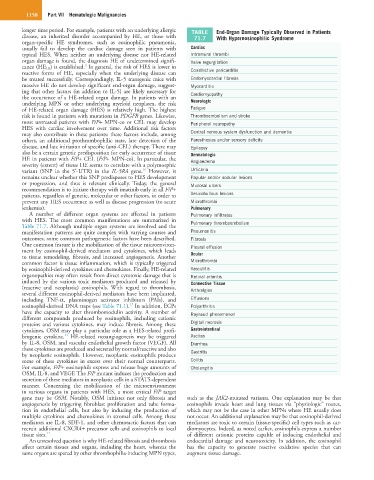
        longer time period. For example, patients with an underlying allergic   TABLE   End-Organ Damage Typically Observed in Patients
        disease,  an  inherited  disorder  accompanied  by  HE,  or  those  with   71.7  With Hypereosinophilic Syndrome
        organ-specific  HE  syndromes,  such  as  eosinophilic  pneumonia,
        usually  fail  to  develop  the  cardiac  damage  seen  in  patients  with   Cardiac
        typical  HES.  When  neither  an  underlying  disease  nor  HE-related   Intramural thrombi
        organ damage is found, the diagnosis HE of undetermined signifi-  Valve regurgitation
                             3
        cance (HE US ) is established.  In general, the risk of HES is lower in
        reactive  forms  of  HE,  especially  when  the  underlying  disease  can   Constrictive pericarditis
        be treated successfully. Correspondingly, IL-5 transgenic mice with   Endomyocardial fibrosis
        massive HE do not develop significant end-organ damage, suggest-  Myocarditis
        ing that other factors (in addition to IL-5) are likely necessary for   Cardiomyopathy
        the occurrence of a HE-related organ damage. In patients with an
        underlying  MPN  or  other  underlying  myeloid  neoplasm,  the  risk   Neurologic
        of HE-related organ damage (HES) is relatively high. The highest   Fatigue
        risk is found in patients with mutations in PDGFR genes. Likewise,   Thromboembolism and stroke
        most  untreated patients  with  F/P+  MPN-eo or CEL  may  develop   Peripheral neuropathy
        HES  with  cardiac  involvement  over  time.  Additional  risk  factors
        may also contribute in these patients: these factors include, among   Central nervous system dysfunction and dementia
        others,  an  additional  prothrombophilic  state,  late  detection  of  the   Paresthesias and/or sensory deficits
        disease, and late initiation of specific (anti-CEL) therapy. There may   Epilepsy
        also be a certain genetic predisposition for early occurrence of tissue   Dermatologic
        HE in patients with F/P+ CEL (F/P+ MPN-eo). In particular, the   Angioedema
        severity (extent) of tissue HE seems to correlate with a polymorphic
                                                16
        variant  (SNP  in  the  5′-UTR)  in  the  IL-5RA  gene.   However,  it   Urticaria
        remains unclear whether this SNP predisposes to HES development   Papular and/or nodular lesions
        or  progression,  and  thus  is  relevant  clinically.  Today,  the  general   Mucosal ulcers
        recommendation is to initiate therapy with imatinib early in all F/P+
        patients, regardless of genetic, molecular or other factors, in order to   Vesicobullous lesions
        prevent any HES occurrence as well as disease progression (to acute     Microthrombi
        leukemia).                                             Pulmonary
           A  number  of  different  organ  systems  are  affected  in  patients   Pulmonary infiltrates
        with  HES.  The  most  common  manifestations  are  summarized  in   Pulmonary thromboembolism
        Table 71.7. Although multiple organ systems are involved and the
        manifestation patterns are quite complex with varying courses and   Pneumonitis
        outcomes, some common pathogenetic factors have been described.   Fibrosis
        One common feature is the mobilization of the tissue microenviron-  Pleural effusion
        ment  by  eosinophil-derived  mediators  and  cytokines,  which  leads   Ocular
        to  tissue  remodeling,  fibrosis,  and  increased  angiogenesis.  Another
        common factor is tissue inflammation, which is typically triggered   Microthrombi
        by eosinophil-derived cytokines and chemokines. Finally, HE-related   Vasculitis
        organopathies may often result from direct cytotoxic damage that is   Retinal arteritis
        induced  by  the  various  toxic  mediators  produced  and  released  by   Connective Tissue
        (reactive  and  neoplastic)  eosinophils.  With  regard  to  thrombosis,   Arthralgias
        several different eosinophil-derived mediators have been implicated,
        including  TNF-α,  plasminogen  activator  inhibitors  (PAIs),  and   Effusions
                                           17
        eosinophil-derived DNA traps (see Table 71.1).  In addition, ECPs   Polyarthritis
        have  the  capacity  to  alter  thrombomodulin  activity.  A  number  of   Raynaud phenomenon
        different  compounds  produced  by  eosinophils,  including  cationic
        proteins  and  various  cytokines,  may  induce  fibrosis.  Among  these   Digital necrosis
        cytokines, OSM may play a particular role as a HES-related profi-  Gastrointestinal
                      11
        brogenic  cytokine.   HE-related  neoangiogenesis  may  be  triggered   Ascites
        by IL-8, OSM, and vascular endothelial growth factor (VEGF). All   Diarrhea
        these cytokines are produced and secreted by normal/reactive and also   Gastritis
        by neoplastic eosinophils. However, neoplastic eosinophils produce
        some  of  these  cytokines  in  excess  over  their  normal  counterparts.   Colitis
        For example, F/P+ eosinophils express and release huge amounts of   Cholangitis
        OSM, IL-8, and VEGF. The F/P mutant induces the production and
        secretion of these mediators in neoplastic cells in a STAT5-dependent
        manner.  Concerning  the  mobilization  of  the  microenvironment
        in various organs in patients with HES, a most critical F/P target
        gene  may  be  OSM.  Notably,  OSM  initiates  not  only  fibrosis  and   such  as  the  JAK2-mutated  variants.  One  explanation  may  be  that
        angiogenesis  by  triggering  fibroblast  proliferation  and  tube  forma-  eosinophils  invade  heart  and  lung  tissues  via  “physiologic”  routes,
        tion  in  endothelial  cells,  but  also  by  inducing  the  production  of   which may not be the case in other MPNs where HE usually does
        multiple  cytokines  and  chemokines  in  stromal  cells.  Among  these   not occur. An additional explanation may be that eosinophil-derived
        mediators are IL-8, SDF-1, and other chemotactic factors that can   mediators are toxic to certain (tissue-specific) cell types such as car-
        recruit additional CXCR4+ precursor cells and eosinophils to local   diomyocytes. Indeed, as noted earlier, eosinophils express a number
        tissue sites. 11                                      of  different  cationic  proteins  capable  of  inducing  endothelial  and
           An unresolved question is why HE-related fibrosis and thrombosis   endocardial  damage  and  neurotoxicity.  In  addition,  the  eosinophil
        affect  certain  tissues  and  organs,  including  the  heart,  whereas  the   has  the  capacity  to  generate  reactive  oxidative  species  that  can
        same organs are spared by other thrombophilia-inducing MPN types,   augment tissue damage.

