


Page 1314 - Hematology_ Basic Principles and Practice ( PDFDrive )
P. 1314
1160   Part VII  Hematologic Malignancies


                                                     Hypereosinophilia = HE

                                                                              Familial HE = HE F  + Organ
                                                   Screen for secondary causes  Familial HES = HES F  damage
                  + Organ   Reactive HE = HE R
                  damage    Reactive HES = HES R   Positive
                                                               Negative           Rare syndromes
                                                                                  − Hereditary
                      Explore underlying cause                                    − Non-hereditary
                     →Establish the final diagnosis                               − Mono-organ
                                   Positive  Screen for FIP1L1-PDGFRA by FISH or RT-PCR,
                                           and perform cytogenetic analysis for translocations
                                            involving 4q12 (PDGFRA), 5q31-q33 (PDGFRB),
                                                      or 8p11-12 (FGFR1)

                     WHO-based myeloid or
                  lymphoid neoplasm with HE and                Negative
                    abnormalities of PDGFRA,
                      PDGFRB or FGFR1            Screen for other molecular markers  Abnormal T-cell
                                                    and hematologic diseases     phenotype ± Th2
                                                                               cytokine production ?
                 Define the histopathological and clinical                                Yes
                   nature of the underlying neoplasm
                    →Establish the final diagnosis  Other molecular abnormality, clonal  No  Lymphocyte-variant
                                                   eosinophils, and/or increased     hypereosinophilia
                           WHO-defined myeloid      marrow blasts (≥5−19%) ?
                           neoplasm associated                                               HES
                             with eosinophilia                 Yes     No     HE of unknown     L  + Organ
                                                                            significance = HE US  damage
                                                      Chronic eosinophilic
                    + Organ                             leukemia, NOS       Idiopathic HES = HES I
                    damage      Neoplastic HES = HES N               + Organ
                                                                     damage
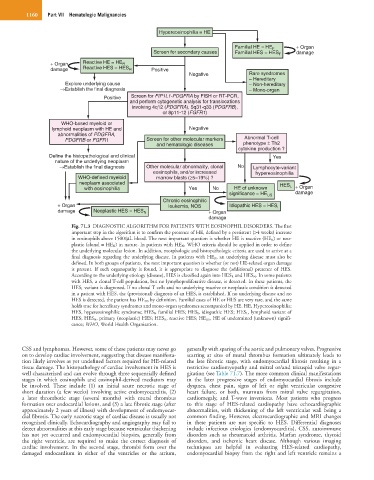
                        Fig. 71.3  DIAGNOSTIC ALGORITHM FOR PATIENTS WITH EOSINOPHIL DISORDERS. The first
                        important step in the algorithm is to confirm the presence of HE, defined by a persistent (>4 weeks) increase
                        in eosinophils above 1500/µL blood. The next important question is whether HE is reactive (HE R ) or neo-
                        plastic (clonal = HE N ) in nature. In patients with HE N , WHO criteria should be applied in order to define
                        the underlying molecular lesion. In addition, morphologic and histopathologic criteria are used to arrive at a
                        final diagnosis regarding the underlying disease. In patients with HE R , an underlying disease must also be
                        defined. In both groups of patients, the next important question is whether (or not) HE-related organ damage
                        is  present.  If  such  organopathy  is  found,  it  is  appropriate  to  diagnose  the  (additional)  presence  of  HES.
                        According to the underlying etiology (disease), HES is classified again into HES R  and HES N . In some patients
                        with HES, a clonal T-cell population, but no lymphoproliferative disease, is detected. In these patients, the
                        HES L  variant is diagnosed. If no clonal T cells and no underlying reactive or neoplastic condition is detected
                        in a patient with HES, the (provisional) diagnosis of an HES I  is established. If no underlying disease and no
                        HES is detected, the patient has HE US  by definition. Familial cases of HE or HES are very rare, and the same
                        holds true for hereditary syndromes and mono-organ syndromes accompanied by HE. HE, Hypereosinophilia;
                        HES, hypereosinophilic syndrome; HES F , familial HES; HES I , idiopathic HES; HES L , lymphoid variant of
                        HES; HES N , primary (neoplastic) HES; HES R , reactive HES; HE US , HE of undermined (unknown) signifi-
                        cance; WHO, World Health Organisation.


        CSS and lymphomas. However, some of these patients may never go   generally with sparing of the aortic and pulmonary valves. Progressive
        on to develop cardiac involvement, suggesting that disease manifesta-  scarring  at  sites  of  mural  thrombus  formation  ultimately  leads  to
        tion likely involves as yet undefined factors required for HE-related   the  late  fibrotic  stage,  with  endomyocardial  fibrosis  resulting  in  a
        tissue damage. The histopathology of cardiac involvement in HES is   restrictive cardiomyopathy and mitral or/and tricuspid valve regur-
        well characterized and can evolve through three sequentially defined   gitation (see Table 71.7). The more common clinical manifestations
        stages  in  which  eosinophils  and  eosinophil-derived  mediators  may   in  the  later  progressive  stages  of  endomyocardial  fibrosis  include
        be  involved.  These  include  (1)  an  initial  acute  necrotic  stage  of   dyspnea,  chest  pain,  signs  of  left  or  right  ventricular  congestive
        short duration (a few weeks) involving active endomyocarditis, (2)   heart  failure,  or  both,  murmurs  from  mitral  valve  regurgitation,
        a  later  thrombotic  stage  (several  months)  with  mural  thrombus   cardiomegaly,  and  T-wave  inversions.  Most  patients  who  progress
        formation over endocardial lesions, and (3) a late fibrotic stage (after   to  this  stage  of  HES-related  cardiopathy  have  echocardiographic
        approximately 2 years of illness) with development of endomyocar-  abnormalities,  with  thickening  of  the  left  ventricular  wall  being  a
        dial fibrosis. The early necrotic stage of cardiac disease is usually not   common finding. However, electrocardiographic and MRI changes
        recognized clinically. Echocardiography and angiography may fail to   in  these  patients  are  not  specific  to  HES.  Differential  diagnoses
        detect abnormalities at this early stage because ventricular thickening   include  infectious  etiologies  (endomyocarditis),  CSS,  autoimmune
        has  not  yet  occurred  and  endomyocardial  biopsies,  generally  from   disorders  such  as  rheumatoid  arthritis,  Marfan  syndrome,  thyroid
        the  right  ventricle,  are  required  to  make  the  correct  diagnosis  of   disorders,  and  ischemic  heart  disease.  Although  various  imaging
        cardiac  involvement.  In  the  second  stage,  thrombi  form  over  the   techniques  are  helpful  in  evaluating  HES-related  cardiopathy,
        damaged  endocardium  in  either  of  the  ventricles  or  the  atrium,   endomyocardial biopsy from the right and left ventricle remains a

